If you ever want to find a superb Mexican restaurant (and who doesn't?) and are near Herndon, Virginia, check out Teocalli Tamale at 336 Elden St, Herndon, VA, 20170, +1 703 904 9336. They are fantastic!
Mike, the owner, started Teocali Tamale in Colorado and brought the slow-roasted tradition to Virginia. The restaurant itself is a small hole-in-the-wall in a strip mall, but classic Blues play inside and the food is just wonderful. Give 'em a try! I plan to hold all my lunch meetings there for the forseeable future.
Tuesday, December 13, 2005


Friday, December 02, 2005
Explaining the Debate on Iraq
The debate on the war in Iraq is simple to explain. Why do our professional warriors insist that the war can be won? Because it is their job to believe they can win. They want to win. They demand to win. They would insist on victory even if (especially if) they were fighting an unbeatable enemy on the streets of Washington, D.C. Any war strategy based on asking the military whether they think they can win is doomed to failure.
That is yet another reason why an enlightened country should actively avoid war, and yet fight any it is forced into to the death. Unfortunately, we were not forced into this war; we sought it and are now paying the price, much as we paid the price for the ridiculously aggressive Spanish-American War or the ill-conceived Vietnam War.
How many times must we be told that causing and then fighting a serious insurgency is a bad idea? History tells us that, as do the current insurgencies around the world. Not one of them is being truly won. At best, they fall into an uncomfortable pseudo peace, for a while.
Better to lead in a way that others will follow, as Congressman Ron Paul said in 2002 - and complained that he was being attacked as a terrorist sympathizer for following the foreign policy ideals of America's founding fathers. We lead the world when we are better than our enemies, not when we engage in torture, plant propaganda in the foreign press and otherwise act as ignorant and ill-behaved as they are.
To make matters right, we must lead morally. Only then will the world follow.
I believe that America is acting in inappropriate ways for the simple reason that we all want to, sometimes. It is a normal emotional response in our leaders to lash out at what we do not understand and to do so with force. The only thing that prevents that overreaction is the calming action of the balance of governmental powers. The only way to save America from itself is to restore the limitations once imposed on the executive branch by policy. A new check on the Administration's ability to wield military power, unreliant on policy, is needed.
That is yet another reason why an enlightened country should actively avoid war, and yet fight any it is forced into to the death. Unfortunately, we were not forced into this war; we sought it and are now paying the price, much as we paid the price for the ridiculously aggressive Spanish-American War or the ill-conceived Vietnam War.
How many times must we be told that causing and then fighting a serious insurgency is a bad idea? History tells us that, as do the current insurgencies around the world. Not one of them is being truly won. At best, they fall into an uncomfortable pseudo peace, for a while.
Better to lead in a way that others will follow, as Congressman Ron Paul said in 2002 - and complained that he was being attacked as a terrorist sympathizer for following the foreign policy ideals of America's founding fathers. We lead the world when we are better than our enemies, not when we engage in torture, plant propaganda in the foreign press and otherwise act as ignorant and ill-behaved as they are.
To make matters right, we must lead morally. Only then will the world follow.
I believe that America is acting in inappropriate ways for the simple reason that we all want to, sometimes. It is a normal emotional response in our leaders to lash out at what we do not understand and to do so with force. The only thing that prevents that overreaction is the calming action of the balance of governmental powers. The only way to save America from itself is to restore the limitations once imposed on the executive branch by policy. A new check on the Administration's ability to wield military power, unreliant on policy, is needed.
Tuesday, November 22, 2005
XTech 2006 Call for Participation
The Call for Participation for XTech 2006 (formerly XML Europe) is now available. The conference will be 16-19 May 2006 in Amsterdam (note that WWW 2006 is 23-26 May in Scotland). The track that includes SemWeb, tagging, microformats is entitled "Open Data".
Papers at this conference are selected by peer review of *abstracts*.
The important dates are:
9 January / Presentation and Tutorial Proposals Due
10 February / Accepted Speakers Notified
17 March / Late Breaking News & Product Proposals Due
I presented the Kowari overview paper at XTech 2005, which was also in Amsterdam. It was a lot like WWW, only less so. A number of the speakers overlapped, as did the content and focus. If you can't get to WWW, XTech is a reasonable choice.
Papers at this conference are selected by peer review of *abstracts*.
The important dates are:
9 January / Presentation and Tutorial Proposals Due
10 February / Accepted Speakers Notified
17 March / Late Breaking News & Product Proposals Due
I presented the Kowari overview paper at XTech 2005, which was also in Amsterdam. It was a lot like WWW, only less so. A number of the speakers overlapped, as did the content and focus. If you can't get to WWW, XTech is a reasonable choice.
Trip Report from WISE 2005's International Workshop on Scalable Semantic Web Knowledge Base Systems (SSWS 2005)
On Sunday, 20 November 2005, I attended the International Workshop on Scalable Semantic Web Knowledge Base Systems (SSWS 2005), held as part of The 6th International Conference on Web Information Systems Engineering (WISE 2005) in New York City. Whew! That is a rather fancy way of saying that I spent a weekend day working in a small conference room with twenty SemWeb geeks, about half of whom I already knew.
Semantic Web repositories were well represented: Dave Beckett, creator of Redland, Steve Harris of 3Store and Alex Hall and myself from Kowari.
I was on the program committee for the workshop and presented a short paper entitled "Scaling the Kowari Metastore" [1]. That paper surveyed the options to keep Kowari as the most scalable SemWeb database. I hope we will get the chance to implement some of them in 2006 so we can keep ahead of the game.
Dave Beckett moved from the University of Manchester to Yahoo! in October 2005. It is interesting to see Yahoo! hiring SemWeb people and reportedly using them on SemWeb projects.
The most interesting talk (to me) was on a new repository for OWL data called OWLIM [2]. The talk was given by primary author Atanas Kiryakov. OWLIM supports RDFS and OWL DLP and (yet another) variant he called "OWL Horst", based on a ISWC 2005 paper written by H.J. ter Horst [3].
Owl Horst is an RDFS-compatible OWL fragment which allows extensions with rules. It contains less Description Logic than OWL Lite, but more capability for rules extensibility. OWL Horst provides entailment over RDF graphs based on rules of triple patterns, with variables at any position (subject, object and/or predicate).
Atanas said that general rules extensibility in OWLIM is "possible"; which probably means that they have not exposed a generic rules engine yet. Interestingly, InverseFunctionalProperty is included as a primitive property. No cardinality constraints are included, though, which I contend limits its usefulness with ontologies dealing with business data.
OWLIM is available as a Storage and Retrieval Layer (SAIL) for Sesame. Unfortunately, although it is Open Source (LGPL), it runs on Ontotext's TRREE engine, which is freely available but proprieary to Ontotext. OWLIM reportedly has very fast upload, and retreival/query speeds, but relatively slow deletes. Its scalability becomes limited with high implicit/explicit statement ratios. They claim 30 million statements as an upper limit on reasonable hardware (64-bit Opteron), 10 million on 32-bit desktops. It is written in Java 1.5. Query speeds are claimed to be linear with data size; delete time is also linear (20 sec per million statements present).
Atanas strongly encourged the Kowari team to head toward an implementation of OWL Horst instead of the OWL Lite plus full cardinality support that we planned. I will have to look into whether we could add full cardinality to OWL Horst. If we can, it sounds like a reasonable thing to do.
Steve Harris presented his recent work on implementing SPARQL in his 3Store RDF repository [4]. 3Store is written in C and uses mySQL as a storage backend. Steve has managed to auto-generate reasonable SQL from SPARQL to allow 3Store to handle some tens of millions (up to 35 million) of RDF statements. He did not implement SPARQL's nested optional, nested union or case-insensitive regexps, but that still makes it nearly complete with the SPARQL specification.
I am sure that Steve's work will come in really handy for Oracle, if they look at it. No one from Oracle was in attendance.
Denis Ranger from Mind Alliance presented his work with Jean-Francois Cloutier on a query algorithm for scalable SemWeb P2P systems [5]. Their algorithm relies on Pastry and Scribe, both created by Microsoft Research (A non-interoperable FreePastry implementation has been released under a BSD-like license from Rice University.) Data routing is handled by Pastry; peers are connected to a small set of neighbors and the connections are rebalanced automatically as peers come and go. Scribe provides publish and subscribe message- and topic-handling. They are working on a simulation and I look forward to seeing it work.
It is interesting that several researchers have been using the Lehigh University Benchmark (LUBM) data to benchmark OWL-oriented systems. It seems to be becoming a de facto standard.
References:
[1] Wood, D., Scaling the Kowari Metastore, in Dean, M., et al. (Eds.): WISE 2005 Workshops, LNCS 3807, pp. 193-198, 2005.
[2] Kiryakov, A., Ognyanov, D., and Manov, D., OWLIM- A Pragmatic Semantic Repository for OWL, in Dean, M., et al. (Eds.): WISE 2005 Workshops, LNCS 3807, pp. 182-192, 2005.
[3] ter Horst, H.J., Combining RDF and part of OWL with Rules: Semantics, Decidability, Complexity. In Proc of ISWC 2005.
[4] Harris, S., SPARQL Query Processing with Conventional Relational Database Systems, in Dean, M., et al. (Eds.): WISE 2005 Workshops, LNCS 3807, pp. 235-244, 2005.
[5] Ranger, D. and Cloutier, J.F., Scalable Peer-to-Peer RDF Query Algorithm, in Dean, M., et al. (Eds.): WISE 2005 Workshops, LNCS 3807, pp. 266-274, 2005.
Semantic Web repositories were well represented: Dave Beckett, creator of Redland, Steve Harris of 3Store and Alex Hall and myself from Kowari.
I was on the program committee for the workshop and presented a short paper entitled "Scaling the Kowari Metastore" [1]. That paper surveyed the options to keep Kowari as the most scalable SemWeb database. I hope we will get the chance to implement some of them in 2006 so we can keep ahead of the game.
Dave Beckett moved from the University of Manchester to Yahoo! in October 2005. It is interesting to see Yahoo! hiring SemWeb people and reportedly using them on SemWeb projects.
The most interesting talk (to me) was on a new repository for OWL data called OWLIM [2]. The talk was given by primary author Atanas Kiryakov. OWLIM supports RDFS and OWL DLP and (yet another) variant he called "OWL Horst", based on a ISWC 2005 paper written by H.J. ter Horst [3].
Owl Horst is an RDFS-compatible OWL fragment which allows extensions with rules. It contains less Description Logic than OWL Lite, but more capability for rules extensibility. OWL Horst provides entailment over RDF graphs based on rules of triple patterns, with variables at any position (subject, object and/or predicate).
Atanas said that general rules extensibility in OWLIM is "possible"; which probably means that they have not exposed a generic rules engine yet. Interestingly, InverseFunctionalProperty is included as a primitive property. No cardinality constraints are included, though, which I contend limits its usefulness with ontologies dealing with business data.
OWLIM is available as a Storage and Retrieval Layer (SAIL) for Sesame. Unfortunately, although it is Open Source (LGPL), it runs on Ontotext's TRREE engine, which is freely available but proprieary to Ontotext. OWLIM reportedly has very fast upload, and retreival/query speeds, but relatively slow deletes. Its scalability becomes limited with high implicit/explicit statement ratios. They claim 30 million statements as an upper limit on reasonable hardware (64-bit Opteron), 10 million on 32-bit desktops. It is written in Java 1.5. Query speeds are claimed to be linear with data size; delete time is also linear (20 sec per million statements present).
Atanas strongly encourged the Kowari team to head toward an implementation of OWL Horst instead of the OWL Lite plus full cardinality support that we planned. I will have to look into whether we could add full cardinality to OWL Horst. If we can, it sounds like a reasonable thing to do.
Steve Harris presented his recent work on implementing SPARQL in his 3Store RDF repository [4]. 3Store is written in C and uses mySQL as a storage backend. Steve has managed to auto-generate reasonable SQL from SPARQL to allow 3Store to handle some tens of millions (up to 35 million) of RDF statements. He did not implement SPARQL's nested optional, nested union or case-insensitive regexps, but that still makes it nearly complete with the SPARQL specification.
I am sure that Steve's work will come in really handy for Oracle, if they look at it. No one from Oracle was in attendance.
Denis Ranger from Mind Alliance presented his work with Jean-Francois Cloutier on a query algorithm for scalable SemWeb P2P systems [5]. Their algorithm relies on Pastry and Scribe, both created by Microsoft Research (A non-interoperable FreePastry implementation has been released under a BSD-like license from Rice University.) Data routing is handled by Pastry; peers are connected to a small set of neighbors and the connections are rebalanced automatically as peers come and go. Scribe provides publish and subscribe message- and topic-handling. They are working on a simulation and I look forward to seeing it work.
It is interesting that several researchers have been using the Lehigh University Benchmark (LUBM) data to benchmark OWL-oriented systems. It seems to be becoming a de facto standard.
References:
[1] Wood, D., Scaling the Kowari Metastore, in Dean, M., et al. (Eds.): WISE 2005 Workshops, LNCS 3807, pp. 193-198, 2005.
[2] Kiryakov, A., Ognyanov, D., and Manov, D., OWLIM- A Pragmatic Semantic Repository for OWL, in Dean, M., et al. (Eds.): WISE 2005 Workshops, LNCS 3807, pp. 182-192, 2005.
[3] ter Horst, H.J., Combining RDF and part of OWL with Rules: Semantics, Decidability, Complexity. In Proc of ISWC 2005.
[4] Harris, S., SPARQL Query Processing with Conventional Relational Database Systems, in Dean, M., et al. (Eds.): WISE 2005 Workshops, LNCS 3807, pp. 235-244, 2005.
[5] Ranger, D. and Cloutier, J.F., Scalable Peer-to-Peer RDF Query Algorithm, in Dean, M., et al. (Eds.): WISE 2005 Workshops, LNCS 3807, pp. 266-274, 2005.
$100 Green Machine Debuts at UN
Nicholas Negroponte and Kofi Annan demoed the Green Machine last week at the United Nations (stories at BBC, New Scientist, IEEE Spectrum). This is the coolest thing I have seen in a long, long time! It is meant to bring a reasonable level of computing to the poor children of the world.
The Green Machine is a sub-$100 laptop computer powered by a hand-cranked dynamo. It contains a simple, dual-mode bright LED screen to save power (no backlighting) and includes mesh networking capabilities to share Internet connections or just create ad-hoc networks. Naturally, it uses exclusively Open Source software, both to keep the price down and to facilitate internationalization to the world's poorest countries who are not a market force.
Professor Negroponte thinks he can get millions of these things built in short order and plans to sell them to governments, presumably opening the way for grants to help. Go, man, go!
The Green Machine is a sub-$100 laptop computer powered by a hand-cranked dynamo. It contains a simple, dual-mode bright LED screen to save power (no backlighting) and includes mesh networking capabilities to share Internet connections or just create ad-hoc networks. Naturally, it uses exclusively Open Source software, both to keep the price down and to facilitate internationalization to the world's poorest countries who are not a market force.
Professor Negroponte thinks he can get millions of these things built in short order and plans to sell them to governments, presumably opening the way for grants to help. Go, man, go!
Monday, November 14, 2005
Decent VIM RegExp Guide
I finally found a decent, readable guide to regular expressions in vim: http://www.geocities.com/volontir/. Yay!
Sunday, November 13, 2005
Guitar Lessons
Well, I've done it again. Just as my life was starting to get a bit less frenetic I've taken on another project. My friend Naser took my to the Guitar Center in Fairfax and I bought a Yamaha six-string acoustic guitar. I haven't done a bit of work in the last several days, spending my time instead trying to wrap my short fingers around the eight basic chords described in Guitar Noise's Asolute Beginner series of articles. Naser is going to give me my first formal lesson on Friday.
I always thought computers were a terrible time sink. You start coding and hours just slip by. Guitars, at first glance, would seem to be worse.
I always thought computers were a terrible time sink. You start coding and hours just slip by. Guitars, at first glance, would seem to be worse.
Wednesday, November 02, 2005
Tufte Course Review
I attended a one-day course on data graphics yesterday, given by the justly-famous Edward Tufte. I highly recommend both the course and his books, but, as usual, have some comments.
The best parts of the course were his introduction to sparklines and his comments on the deleterious effects of Microsoft Powerpoint.
Tufte recommends a radical increase in the information density of documents and presentations. That gives documents and presentations more readability and assists the retention of information.
However, such a significant increase in information density means that in order to create a Tufte-approved presentation, one must take the time and effort to include all that additional information. One will not always have the time to do that. Office workers, military officers, stock traders and others in operational roles are often required to brief quickly, before ideas are fully formed. This, of course, never happens in science. Tufte notes that his first book required twelve years to write.
Blaise Pascal once apologized for writing a long letter, saying "The present letter is a very long one, simply because I had no leisure to make it shorter." In other words, he was saying that he did not choose to spend the time to radically increase the information density. That is an economic decision and, as we all know, all engineering is economics. Thanks to Brian S. for properly attributing the quote.
I noticed one other interesting phenomenon. At the end of the day, Prof. Tufte ended the lecture, the audience applauded and he waved. Then he basked in the applause, like a rock star or a politician. The last person I saw enjoy applause that much was Bill Clinton. Tufte has commented that his reviewers never include graphics, so here is my rendition of him basking in applause: . The image is, of course, a play on his "airport signal people".
Still, the course was interesting and thought provoking. I highly recommend it as an addendum to reading his books.
The best parts of the course were his introduction to sparklines and his comments on the deleterious effects of Microsoft Powerpoint.
Tufte recommends a radical increase in the information density of documents and presentations. That gives documents and presentations more readability and assists the retention of information.
However, such a significant increase in information density means that in order to create a Tufte-approved presentation, one must take the time and effort to include all that additional information. One will not always have the time to do that. Office workers, military officers, stock traders and others in operational roles are often required to brief quickly, before ideas are fully formed. This, of course, never happens in science. Tufte notes that his first book required twelve years to write.
Blaise Pascal once apologized for writing a long letter, saying "The present letter is a very long one, simply because I had no leisure to make it shorter." In other words, he was saying that he did not choose to spend the time to radically increase the information density. That is an economic decision and, as we all know, all engineering is economics. Thanks to Brian S. for properly attributing the quote.
I noticed one other interesting phenomenon. At the end of the day, Prof. Tufte ended the lecture, the audience applauded and he waved. Then he basked in the applause, like a rock star or a politician. The last person I saw enjoy applause that much was Bill Clinton. Tufte has commented that his reviewers never include graphics, so here is my rendition of him basking in applause:
. The image is, of course, a play on his "airport signal people".Still, the course was interesting and thought provoking. I highly recommend it as an addendum to reading his books.
Monday, October 31, 2005
The Legacy of Rosa Parks
Bernadette went to the Capitol last night to see Rosa Parks lying in state. The Capitol Police reported that 30,000 people made it through (Bernadette left when she realized it was a six hour wait after midnight).
I have admired Mrs. Parks for one simple reason: At a time when full-grown men were scared to stand up to injustice, she did. Now I admire her more for something else. Bernadette says that only about one third of the people in line were black. Mrs. Parks managed to transcend race in America while bringing people together and that is a difficult thing.
I have admired Mrs. Parks for one simple reason: At a time when full-grown men were scared to stand up to injustice, she did. Now I admire her more for something else. Bernadette says that only about one third of the people in line were black. Mrs. Parks managed to transcend race in America while bringing people together and that is a difficult thing.
Saturday, October 29, 2005
Kowari v1.1 in Code Freeze
I am pleased to announce that Kowari v1.1 is now in code freeze. I will set up the CVS repository for v1.2 shortly.
The MP3 and Filesystem Resolvers were removed for this release due to the need to forward-port that tutorial to use the new permanent model names. It was worth it; having permanent model names which are not associated with a URL fixes several bugs and will reduce headaches for people using Kowari on laptops or any host which changes names regularly.
All test are finally passing and we are well on our way to our first real release as a project after Tucana's demise.
The MP3 and Filesystem Resolvers were removed for this release due to the need to forward-port that tutorial to use the new permanent model names. It was worth it; having permanent model names which are not associated with a URL fixes several bugs and will reduce headaches for people using Kowari on laptops or any host which changes names regularly.
All test are finally passing and we are well on our way to our first real release as a project after Tucana's demise.
Saturday, October 22, 2005
Refuting "Irreducible Complexity"
Bernadette and I attended a fascinating seminar at AAAS on Thursday entitled, "Evolution of Biological Complexity". It was part of AAAS's Dialogue on Science, Ethics and Religion (DoSER) lecture series. The speaker was Chistoph Adami, a professor of Applied Life Sciences at Keck Graduate Institute and a researcher at Cal Tech.
Prof. Adami discussed his most recent research on the Avida software, which simulates Darwinian evolution in silico. The Avida group has managed to show how complex adaptive traits can evolve using only the Darwinian algorithm via the accumulation of mutations. This is a stunning (although, in evolutionary camps, not unexpected) breakthrough in theorectical evolution.
A quick summary of the problem and its recent solution goes like this: Intelligent Designists say that certain biological features are far too complex to have been evolved using Darwin's algorithm. They (especially Lehigh University biochemistry professor Michael Behe) have claimed that since very complex structures (say, for example, the eye) rely on the simultaneous activation of many (tens, hundreds, thousands) of genes, they could not possibly evolve by successive single mutations. This is known as "irreducible complexity", because the complex nature of the structure is not thought to be reducible into a series of single mutations. Adami and Avida have shown otherwise.
Avida has been used to evolve a set of computer programs which compete for CPU time in a race to find solutions to mathematical problems. Adami presented an example of the equality operator, evolved from a series of NAND operations, which required the simultaneous activation of some 20 "genes". He then went on to dissect the history of the evolved operator, showing that it was not active until the last (single gene) mutation, but all the intermediate states were, in fact, functional. Several simpler operators (e.g. AND) were evolved and then lost on the way towards EQU. Surprisingly, the evolutionary train of mutations included several mutations which were downright harmful to the program, severely reducing its fitness. These deleterious mutations survived just long enough to pass on their genes to an offspring which was then mutated in a positive manner. Thus, an examplar structure which met all criteria for "irreducible complexity" was shown to be, in fact, both evolable and emminently reducible.
Importantly, this breakthrough specifically refutes the argument most commonly used by proponents of "Intelligent Design"; that Darwinian evolution cannot account for complex biological features. I hope that this new knowledge can be brought to bear on the recent debates regarding the teaching of evolution in US schools.
Prof. Adami discussed his most recent research on the Avida software, which simulates Darwinian evolution in silico. The Avida group has managed to show how complex adaptive traits can evolve using only the Darwinian algorithm via the accumulation of mutations. This is a stunning (although, in evolutionary camps, not unexpected) breakthrough in theorectical evolution.
A quick summary of the problem and its recent solution goes like this: Intelligent Designists say that certain biological features are far too complex to have been evolved using Darwin's algorithm. They (especially Lehigh University biochemistry professor Michael Behe) have claimed that since very complex structures (say, for example, the eye) rely on the simultaneous activation of many (tens, hundreds, thousands) of genes, they could not possibly evolve by successive single mutations. This is known as "irreducible complexity", because the complex nature of the structure is not thought to be reducible into a series of single mutations. Adami and Avida have shown otherwise.
Avida has been used to evolve a set of computer programs which compete for CPU time in a race to find solutions to mathematical problems. Adami presented an example of the equality operator, evolved from a series of NAND operations, which required the simultaneous activation of some 20 "genes". He then went on to dissect the history of the evolved operator, showing that it was not active until the last (single gene) mutation, but all the intermediate states were, in fact, functional. Several simpler operators (e.g. AND) were evolved and then lost on the way towards EQU. Surprisingly, the evolutionary train of mutations included several mutations which were downright harmful to the program, severely reducing its fitness. These deleterious mutations survived just long enough to pass on their genes to an offspring which was then mutated in a positive manner. Thus, an examplar structure which met all criteria for "irreducible complexity" was shown to be, in fact, both evolable and emminently reducible.
Importantly, this breakthrough specifically refutes the argument most commonly used by proponents of "Intelligent Design"; that Darwinian evolution cannot account for complex biological features. I hope that this new knowledge can be brought to bear on the recent debates regarding the teaching of evolution in US schools.
Thursday, October 20, 2005
Hurricane Katrina Damage
I've been meaning to post this for a while...
My friend Kirk Benson, who served with me on USS Ouellet, is a Navy oceanographer and was responsible for forecasting weather in the New Orleans area. He lived in Slidell, Louisiana, until Hurricane Katrina blew through. Interestingly, he recommended the evacuation of Navy facilities in New Orleans and was sent to Texas before the storm.
Pictures of the damage to his house are here. It all seems a lot more real when you know someone affected.
My friend Kirk Benson, who served with me on USS Ouellet, is a Navy oceanographer and was responsible for forecasting weather in the New Orleans area. He lived in Slidell, Louisiana, until Hurricane Katrina blew through. Interestingly, he recommended the evacuation of Navy facilities in New Orleans and was sent to Texas before the storm.
Pictures of the damage to his house are here. It all seems a lot more real when you know someone affected.
Thomas Schelling Wins Nobel Prize for Economics
Thomas C. Schelling won this year's Nobel Prize for economics, and about time, too.
Schelling's article1 on racial segregation, the earliest agent model of which I am aware, was what started my interest in agent modeling, finite autonoma and other ways of generating complexity from simple rules.
The University of Maryland press release is here, which points to some of his other big works. It looks like I have more reading to do...
[1] Schelling, T. 1969. “Models of Segregation.” American Economic Review 59:488-493.
Schelling's article1 on racial segregation, the earliest agent model of which I am aware, was what started my interest in agent modeling, finite autonoma and other ways of generating complexity from simple rules.
The University of Maryland press release is here, which points to some of his other big works. It looks like I have more reading to do...
[1] Schelling, T. 1969. “Models of Segregation.” American Economic Review 59:488-493.
Tour du monde en dansant
For anyone who likes to travel, Tour du monde en dansant is a must-see. Thanks to brownyPoints for the link.
Wednesday, October 19, 2005
Campbell on Memetics?
It is amazing how many scholars have had some internal model regarding the spread of ideas, and many of them seem rather close to (though few are isomorphic with) Blackmore's memes.
I was just reading in Joseph Campbell's Creative Mythology where he says, "A mythological canon is an organization of symbols, ineffable in import, by which the energies of aspiration are evoked and gathered toward a focus. The message leaps from heart to heart by way of the brain, and where the brain is unpersuaded the message cannot pass. The life then is untouched."
That could be Blackmore's memetics, except I think she would tend to say that the last sentence deviates. For, in her theory, an integration of the idea occurs, mixing either more or less with those already resident. Campbell suggests that some ideas may be completely and utterly dismissed if they contradict a functioning mythological system. I think that is worth paying some serious attention to.
I was just reading in Joseph Campbell's Creative Mythology where he says, "A mythological canon is an organization of symbols, ineffable in import, by which the energies of aspiration are evoked and gathered toward a focus. The message leaps from heart to heart by way of the brain, and where the brain is unpersuaded the message cannot pass. The life then is untouched."
That could be Blackmore's memetics, except I think she would tend to say that the last sentence deviates. For, in her theory, an integration of the idea occurs, mixing either more or less with those already resident. Campbell suggests that some ideas may be completely and utterly dismissed if they contradict a functioning mythological system. I think that is worth paying some serious attention to.
Friday, October 14, 2005
Simple Humanism
The history of science may be thought of as the search for simple rules underlying complex phenomena. This search, as the last couple of hundred years clearly show, has been amazingly, even surprisingly, successful. It seems that the world is more simple at its core than we ever expected.
It is not just physics. Sure, Newton ("F=ma"), Laplace (Nature produces "a great number of phenomena, often very complicated, by of a small number of general laws"), Einstein ("E=mc2") and others lead the way, but our contemporaries are busily extending the concept to many other fields. Stephen Wolfram's finite autonoma have sought to place the entire physical world on a simpler footing. Dawkins and Gould extended Darwin's evolution and made it, if anything, simpler. Joseph Campbell found simple underlying rules in worldwide human mythologies. Susan Blackmore, extending Dawkins, is trying to do it for ideas themselves.
I have started to wonder about humanism as a simplification. Humanism would seem to be an expansion of a human world view due to a simplification of the idea of creation. Humanism places humans again in the center of the perceived universe, capable of creating their own world views and solely responsible for their execution. The cause for this shift in perception is directly tied to the successes of simplification in other fields. It worked for physics, biology, economics, so why not God?
Of course, simple (there's that word again) economics tells us that relying on innate human reactions without long term planning (the Tragedy of the Commons) is a quick road to disaster in an economy based on scarcity. Humanism, therefore, is not a silver bullet to solving the world's problems. It just may allow us, though, to look at our problems more clearly and encourage us, however slightly, to plan for our long term survival instead of awaiting Armageddon to clean up our mess.
It is not just physics. Sure, Newton ("F=ma"), Laplace (Nature produces "a great number of phenomena, often very complicated, by of a small number of general laws"), Einstein ("E=mc2") and others lead the way, but our contemporaries are busily extending the concept to many other fields. Stephen Wolfram's finite autonoma have sought to place the entire physical world on a simpler footing. Dawkins and Gould extended Darwin's evolution and made it, if anything, simpler. Joseph Campbell found simple underlying rules in worldwide human mythologies. Susan Blackmore, extending Dawkins, is trying to do it for ideas themselves.
I have started to wonder about humanism as a simplification. Humanism would seem to be an expansion of a human world view due to a simplification of the idea of creation. Humanism places humans again in the center of the perceived universe, capable of creating their own world views and solely responsible for their execution. The cause for this shift in perception is directly tied to the successes of simplification in other fields. It worked for physics, biology, economics, so why not God?
Of course, simple (there's that word again) economics tells us that relying on innate human reactions without long term planning (the Tragedy of the Commons) is a quick road to disaster in an economy based on scarcity. Humanism, therefore, is not a silver bullet to solving the world's problems. It just may allow us, though, to look at our problems more clearly and encourage us, however slightly, to plan for our long term survival instead of awaiting Armageddon to clean up our mess.
All that Glitters does not, err, SPARQL
I was asked to review and comment on the specification for the SPARQL Query Language for RDF. The full review is here.
In short, I am impressed that the DAWG was able to produce a specification, but I can't help being disappointed in the results.
The Kowari community plans to implement it anyway, since it will become the standard RDF query language, but will have to extend it significantly. The iTQL language will remain the same, but will be deprecated as of the Kowari release which includes a SPARQL implementation extended to include all iTQL features. There is much discussion whether that is indeed practical.
In short, I am impressed that the DAWG was able to produce a specification, but I can't help being disappointed in the results.
The Kowari community plans to implement it anyway, since it will become the standard RDF query language, but will have to extend it significantly. The iTQL language will remain the same, but will be deprecated as of the Kowari release which includes a SPARQL implementation extended to include all iTQL features. There is much discussion whether that is indeed practical.
Tuesday, October 04, 2005
Dates for Kowari 1.1 Release
Kowari version 1.1 dates of interest:
No code changes will be accepted after the code slush unless they impact currently open bugs of priority 8 or greater. Code changes submitted after the code freeze will be applied to a new CVS branch for the following version.
| Code slush | 10 October 2005 |
| Code freeze | 17 October 2005 |
| Documentation freeze | 10 December 2005 |
| Release | 2 January 2006 |
No code changes will be accepted after the code slush unless they impact currently open bugs of priority 8 or greater. Code changes submitted after the code freeze will be applied to a new CVS branch for the following version.
Thursday, September 22, 2005
Northrop Tucana Web Site Up and Running
Northrop Grumman has put up a Northrop-branded Tucana Web site. It is basically Tucana Technologies' old site for the moment with a bit of cleaning, but it is a very positive start for their marketing campaign. www.tucanatech.com now redirects to Northrop.
Wednesday, September 21, 2005
Northrop Grumman Press Release re Tucana Acquisition
Northrop Grumman Corporation (finally) announced the purchase of Tucana Technologies' intellectual property.
Tuesday, September 20, 2005
SPARQL Protocol Review and Comments
I just reviewed the SPARQL Protocol for RDF working draft, now in Last Call at the W3C. The full review is here, but here's a summary:
"It is my (personal) opinion that this document is not ready for publication until the WSDL 2.0 compliance issue in Section 2.2 is resolved. The phrase 'DAWG acknowledges the risk inherent in describing its protocol in an illegal variant of WSDL 2.0' is not sufficient to relieve the working group of its responsibility for interoperability. Indeed, if this specification were to be published without resolution of this issue, I think it is quite likely that WSDL 2.0 implementations would not change to reflect it. That would materially damage the SPARQL Protocol's likelihood of uptake."
"It is my (personal) opinion that this document is not ready for publication until the WSDL 2.0 compliance issue in Section 2.2 is resolved. The phrase 'DAWG acknowledges the risk inherent in describing its protocol in an illegal variant of WSDL 2.0' is not sufficient to relieve the working group of its responsibility for interoperability. Indeed, if this specification were to be published without resolution of this issue, I think it is quite likely that WSDL 2.0 implementations would not change to reflect it. That would materially damage the SPARQL Protocol's likelihood of uptake."
Friday, September 16, 2005
Korean Defense Service Medal
The US Department of Defense announced the creation of the Korean Defense Service Medal (KDSM). The KDSM is a service medal for those who have served in the Republic of Korea. Since I meet the criteria about ten times over, my rack now looks like this:

Of course, I'll never wear it, but I might hang it in my office with the others. It's strange how much that simple recognition of all those damn cold nights on the far side of the world means to me. The Cold War was rarely hot, but it sure was uncomfortable. I think of those days as the most rewarding of my life, when I was closest to history in the making. I sure am glad I waited to have children, though. It was hell on families.
For the record (when my kids read this 30 years from now), the thing on top is a US Navy Surface Warfare Officer (ship driver) qualification. The one on the bottom is a Deep Sea Diving Officer qualification. The ribbons are (from upper left to bottom right): Navy Commendation Medal, Air Force Achievement Medal, Navy Battle Efficiency Ribbon (3 awards), National Defense Service Medal, Korean Defense Service Medal and Navy Sea Service Deployment Ribbon (4 awards).
Of course, I'll never wear it, but I might hang it in my office with the others. It's strange how much that simple recognition of all those damn cold nights on the far side of the world means to me. The Cold War was rarely hot, but it sure was uncomfortable. I think of those days as the most rewarding of my life, when I was closest to history in the making. I sure am glad I waited to have children, though. It was hell on families.
For the record (when my kids read this 30 years from now), the thing on top is a US Navy Surface Warfare Officer (ship driver) qualification. The one on the bottom is a Deep Sea Diving Officer qualification. The ribbons are (from upper left to bottom right): Navy Commendation Medal, Air Force Achievement Medal, Navy Battle Efficiency Ribbon (3 awards), National Defense Service Medal, Korean Defense Service Medal and Navy Sea Service Deployment Ribbon (4 awards).
Memetic Iteration Via Selective Focus
I've been thinking a lot recently about the way that memes change. If Richard Dawkins is right about ideas following an evolutionary algorithm ("memes") and Sue Blackmore is right about the mind being an imitation machine (thus being the home and replicator of memes), then we have to start wondering about the cause of copying errors. After all, errors in replication are key to the evolutionary algorithm. In genetics, the cause seems to be mutation via statistical failures during replication or induced errors afterwards (e.g. by radiation). What is the cause of memetic errors in imitative replication?
I think I found a clue to that last night. It was my wife's birthday and she was opening her presents and reading cards from family and friends. When she read the card from me out loud, my son keyed on a sentence regarding him and burst out, "Hey, Dad, why did you say that?" That was the clue: Aidan heard the entire content of the card, but reacted strongly to only a small portion of it. When asked, his recollection of the card was restricted to the part about him. He missed the main theme because it simply wasn't important to him.
Is selective focus, driven by our own self interest, the key to memetic iteration? I suspect so. It certainly seems to correspond to political spin doctoring (where spin doctors try to find just the right way to describe a situation, self interest being the driving factor), and perhaps even fads. In the creation of fads, each individual seeks to iterate a (generally simple) idea until it strikes the right cord (as determined by positive feedback from onlookers), then it replicates relatively freely. It may change again, as it is picked by people with different ideas of what the right cord is. Marketers, like politicians, try to engineer such phenomena. Therein lies the real danger of a proper science of memetics; if we really get the point of having a full theory, the potential for abuse is much more dangerous than Paul Davies suggests.
I think I found a clue to that last night. It was my wife's birthday and she was opening her presents and reading cards from family and friends. When she read the card from me out loud, my son keyed on a sentence regarding him and burst out, "Hey, Dad, why did you say that?" That was the clue: Aidan heard the entire content of the card, but reacted strongly to only a small portion of it. When asked, his recollection of the card was restricted to the part about him. He missed the main theme because it simply wasn't important to him.
Is selective focus, driven by our own self interest, the key to memetic iteration? I suspect so. It certainly seems to correspond to political spin doctoring (where spin doctors try to find just the right way to describe a situation, self interest being the driving factor), and perhaps even fads. In the creation of fads, each individual seeks to iterate a (generally simple) idea until it strikes the right cord (as determined by positive feedback from onlookers), then it replicates relatively freely. It may change again, as it is picked by people with different ideas of what the right cord is. Marketers, like politicians, try to engineer such phenomena. Therein lies the real danger of a proper science of memetics; if we really get the point of having a full theory, the potential for abuse is much more dangerous than Paul Davies suggests.
Wednesday, September 14, 2005
SPARQL Support Coming for JRDF
Tom has been working on SPARQL support for JRDF and has posted a good status update.
SPARQL could be in JRDF as early as the 0.4 release, which would pave the way for SPARQL in a later release of Kowari. Of course, iTQL still has many more features than SPARQL and there will be some difficulties mapping the two. I still want iTQL to turn into a SPARQL+ (and even - where appropriate, such as UNSAID, unless the DAWG drops it as they are rumored to be considering). I like to think of the future of iTQL's relationship to SPARQL as being analogous to PL/SQL's relationship to the SQL standard. Only time will tell if we can pull that off, but I am hopeful. That approach will require much more than supporting SPARQL in JRDF.
SPARQL could be in JRDF as early as the 0.4 release, which would pave the way for SPARQL in a later release of Kowari. Of course, iTQL still has many more features than SPARQL and there will be some difficulties mapping the two. I still want iTQL to turn into a SPARQL+ (and even - where appropriate, such as UNSAID, unless the DAWG drops it as they are rumored to be considering). I like to think of the future of iTQL's relationship to SPARQL as being analogous to PL/SQL's relationship to the SQL standard. Only time will tell if we can pull that off, but I am hopeful. That approach will require much more than supporting SPARQL in JRDF.
Monday, September 12, 2005
Kowari Memory Leak Found and Fixed
Chris Wilper and his team at The Fedora Project have been embedding Kowari within Fedora for some time. They recently uncovered a memory leak which is caused by a failure to properly clean up unused FreeList$Phase objects in one of the FreeList constructors. The problem shows up when doing many inserts and deletions. Chris quickly tracked down the cause and submitted a patch. Paul G has looked at it, albeit briefly, and will write a test to catch the problem. I expect that Chris' patch will be committed to the Kowari CVS shortly.
All Kowari and Tucana Knowledge Server users should take note of this one! The memory leak exists in both the Kowari 1.0 series and the 1.1 prereleases (including nightly snapshots from CVS), and TKS 2.0 and 2.1 (at least). I suspect (but have not yet verified) that the TKS 1.X series is also affected. The final fix will be in Kowari 1.1 when it comes out in the fourth quarter of this year.
A nice before-and-after plot shows the memory leak and the behavior following Chris' fix.
All Kowari and Tucana Knowledge Server users should take note of this one! The memory leak exists in both the Kowari 1.0 series and the 1.1 prereleases (including nightly snapshots from CVS), and TKS 2.0 and 2.1 (at least). I suspect (but have not yet verified) that the TKS 1.X series is also affected. The final fix will be in Kowari 1.1 when it comes out in the fourth quarter of this year.
A nice before-and-after plot shows the memory leak and the behavior following Chris' fix.
Tuesday, September 06, 2005
The State of Iraq
A friend currently serving with the US military in Iraq sums it up this way: "It will continue to be bloody until we kill them all, they kill us, or they discover the flush toilet and strip malls." I couldn't have said it better myself.
Paper Accepted to SSWS 2005
I wrote a (really crappy - need to fix that) paper entitled, "Scaling the Kowari Metastore", which was was accepted to the 2005 International Workshop on Scalable Semantic Web Knowledge Base Systems (SSWS 2005). SSWS 2005 will be held on 20 November 2005 in conjunction with Sixth International Conference on Web Information Engineering (WISE 2005) in New York City.
First Against the Wall
How does one earn the right to be first against the wall when the revolution comes? Easy: read and travel.
It shocked me to discover that I have acquired a reputation as a "liberal". A fellow engineer even recently referred to me as a "liberal wacko", which is apparently worse. This is in spite of my fiscal conservatism, preference for small government, and relatively hawkish views on foreign policy (though not on wars which do not serve the strategic interest of the US). Yet my childhood friends (most of whom seem to be US Marines), my father and several work colleagues have applied the term "liberal" to me in recent times. Why?
The answer would seem to be that I have travelled enough to form grounded opinions and read enough to understand more about the world than they. When asked, one criticizer complained that I had "left the country" (a reference to my living in Australia for seven years; he was apparently unaware of my three years in Japan with the US Navy.). The same person pointed to my writing that "most" aspects of Islam found distasteful in the West appear to originate in Bedouin culture and not in Sharia (an opinion I'd formed partially after reading the fatwas of Ali Gomaa, currently the Grand Mufti of Egypt). My father complained that I had spent too much time listening to the "liberal agenda" and had picked up some of their ideas, particularly in relation to the war in Iraq. In fact, my objections to the war in Iraq stem simply from the fact that I saw (and see) no strategic interest for the US in pursuing it. Hmmm.
It would seem the only way to be labeled a conservative in the US of 2005 is to agree with everything the president says. That is a dangerous and capricious form of nationalism, which worries me more than even this administration's spendthrift fiscal policies. I know, I know, I'll be first against the wall.
Perhaps Kenneth Quinnell was right when he said, "It is not a coincidence that the two fields most commonly accused of being liberal - journalism and academia - are two fields whose central purpose is the pursuit of truth."
It shocked me to discover that I have acquired a reputation as a "liberal". A fellow engineer even recently referred to me as a "liberal wacko", which is apparently worse. This is in spite of my fiscal conservatism, preference for small government, and relatively hawkish views on foreign policy (though not on wars which do not serve the strategic interest of the US). Yet my childhood friends (most of whom seem to be US Marines), my father and several work colleagues have applied the term "liberal" to me in recent times. Why?
The answer would seem to be that I have travelled enough to form grounded opinions and read enough to understand more about the world than they. When asked, one criticizer complained that I had "left the country" (a reference to my living in Australia for seven years; he was apparently unaware of my three years in Japan with the US Navy.). The same person pointed to my writing that "most" aspects of Islam found distasteful in the West appear to originate in Bedouin culture and not in Sharia (an opinion I'd formed partially after reading the fatwas of Ali Gomaa, currently the Grand Mufti of Egypt). My father complained that I had spent too much time listening to the "liberal agenda" and had picked up some of their ideas, particularly in relation to the war in Iraq. In fact, my objections to the war in Iraq stem simply from the fact that I saw (and see) no strategic interest for the US in pursuing it. Hmmm.
It would seem the only way to be labeled a conservative in the US of 2005 is to agree with everything the president says. That is a dangerous and capricious form of nationalism, which worries me more than even this administration's spendthrift fiscal policies. I know, I know, I'll be first against the wall.
Perhaps Kenneth Quinnell was right when he said, "It is not a coincidence that the two fields most commonly accused of being liberal - journalism and academia - are two fields whose central purpose is the pursuit of truth."
Monday, September 05, 2005
httpRange-14: A Use Case for RDF
Ralph Swick, David Booth and I have been working on a response to the W3C Technical Architecture Group's resolution on the httpRange-14 issue ("# vs. /") as it relates to Semantic Web application developers.
Bascially, we are hoping to define how URIs in RDF statements may be grounded in the Web and still be in compliance with the httpRange-14 resolution. My message to the Semantic Web Best Practices and Deployment Working Group mailing list is here.
Bascially, we are hoping to define how URIs in RDF statements may be grounded in the Web and still be in compliance with the httpRange-14 resolution. My message to the Semantic Web Best Practices and Deployment Working Group mailing list is here.
Thursday, September 01, 2005
The Truth About Dissent
I have a couple of thoughts for my American friends who think that patriotism is best defined by standfast, simpleminded support for a single president's policies:
- "It is the first responsibility of every citizen to question authority." -- Benjamin Franklin
- "Dissent is the highest form of patriotism." -- Thomas Jefferson
- "All men having power ought to be distrusted to a certain degree." -- James Madison
- "If freedom of speech is taken away, then dumb and silent we may be led, like sheep to the slaughter." -- George Washington
A Little Help from our Friends?
The United States of America has an admirable record of sending aid overseas. We are now in desperate times ourselves in New Orleans, and lower Mississippi and Alabama. Where is foriegn aid to those areas? I have a suggestion: Let's ask our Arab friends to send us what they can afford. We could really use a whole lot of sandbags...
Tuesday, August 30, 2005
Kowari v1.1 Pre-release Feature Peek
Kowari version 1.1 is finally close to completion. We expect a code freeze in October, with the release following shortly thereafter. I have posted a quick overview at Sourceforge.
I LOVE being an Engineer
My 7-year-old son was recently given a set of good-quality knights and horses by my sister-in-law. The set came with a small catapult, which fired small, plastic rocks about 3 feet. Naturally, the rocks were soon lost and my son wanted it to shoot farther. With a change in the number, type and placement of the rubber bands, it will now shoot an ice cube far enough to hit the road from our front door (about 28 feet). Now that's fun!
Thursday, August 25, 2005
MIND Lab's PhotoStuff Tool Now Uses Kowari
Mike Grove from UMD's MIND Lab has extended his PhotoStuff SemWeb photo-markup tool to allow metadata storage in Kowari. Metadata associated with images may be stored in either local or remote Kowari servers. If the image being edited is a JPEG, metadata may also be stored directly into the image. Metadata is associated with one or more loaded OWL ontologies. This is very cool and worth a look.
To get the new PhotoStuff with Kowari integration, use the "PhotoStuff 3.0 BETA" link from PhotoStuff Downloads.
Mike has also created a Mindswap Kowari Java Library to abstract access to Kowari. Note the automatic translation from RDQL to iTQL occurring toward the bottom of the page.
To get the new PhotoStuff with Kowari integration, use the "PhotoStuff 3.0 BETA" link from PhotoStuff Downloads.
Mike has also created a Mindswap Kowari Java Library to abstract access to Kowari. Note the automatic translation from RDQL to iTQL occurring toward the bottom of the page.
Staying at The Kendall
I just returned from the semi-annual PAW face-to-face meeting at MIT. Meeting notes are on the PAW site.
We stayed at the historic and beautiful hotel, The Kendall. Future visitors of The Kendall who are male and straight should take note that "hair purifier" is owl:sameAs shampoo and "hair protector" is owl:sameAs conditioner :)
We stayed at the historic and beautiful hotel, The Kendall. Future visitors of The Kendall who are male and straight should take note that "hair purifier" is owl:sameAs shampoo and "hair protector" is owl:sameAs conditioner :)
Wednesday, August 24, 2005
Tyranny of the Majority
"Those who cannot learn from history are doomed to repeat it." So the oft-repeated maxim sometimes attributed to George Santayana tells us. I'm pretty sure that history is being repeated in the Sunni areas of Iraq this week. Many Sunnis decided to boycott the Iraqi national assembly elections earlier this year to focus on fighting an insurgency. They are now left with little representation in the assembly writing the draft constitution. The Kurdish and Shia majority seem intent on punishing the Sunnis for their long support for, and benefits from, the reign of Saddam Hussein. This reminds me of the economic punishment of Germany after World War I, which is widely regarded to have proximately resulted in the nationalism that in turn gave us World War Two, at least in Europe.
George Wilhelm Hegel, while I'm quoting others, reminds us, "What experience and history teach is this -- that people and governments never have learned anything from history, or acted on its principles.", so we should hardly be surprised.
The Sunnis are very likely to be left with little natural resources, an angry populous and a continued strong US military presence. Under such conditions, the insurgency will surely get worse, not better.
Making the economic punishment worse is the religious tension. Joseph Campbell (writing way back in 1964!) correctly identified the source of such tension:
"Now it is signally a fact, signally illustrated in the history of the Levant and particularly in Judaism and Islam, that when religion is identified with a community (or, as we have expressed the idea, with a consensus), and this community, in turn, is not identified with an actual land-based socio-political organism, but with a transcendental principle embodied in the laws of a church or sect, its effects on the local secular body politic, within which it thrives but which it does does identify itself, are inevitable and predictably destructive."[1] (Emphasis mine, to make the central point easier to spot)
Almost everyone will disagree with me on this, but I think we should just admit that the UN charter, which provided the world with the idea that failed states be forced to keep their boundaries, is wrong. This admission is necessary to fix Palestine, the former Yugoslavia, probably Darfor in Sudan and definitely Afghanistan. There is nothing wrong with breaking up Iraq into smaller, stable states. If we admit that such an option exists, we can be part of the solution. We can instigate a process which leaves the Sunnis stable instead of desperate. Desperation breeds violence, more than poverty.
[1] Campbell, Joseph. Occidental Mythology, The Masks of God Volume 4, Penguin Arkana edition, 1991, page 277
George Wilhelm Hegel, while I'm quoting others, reminds us, "What experience and history teach is this -- that people and governments never have learned anything from history, or acted on its principles.", so we should hardly be surprised.
The Sunnis are very likely to be left with little natural resources, an angry populous and a continued strong US military presence. Under such conditions, the insurgency will surely get worse, not better.
Making the economic punishment worse is the religious tension. Joseph Campbell (writing way back in 1964!) correctly identified the source of such tension:
"Now it is signally a fact, signally illustrated in the history of the Levant and particularly in Judaism and Islam, that when religion is identified with a community (or, as we have expressed the idea, with a consensus), and this community, in turn, is not identified with an actual land-based socio-political organism, but with a transcendental principle embodied in the laws of a church or sect, its effects on the local secular body politic, within which it thrives but which it does does identify itself, are inevitable and predictably destructive."[1] (Emphasis mine, to make the central point easier to spot)
Almost everyone will disagree with me on this, but I think we should just admit that the UN charter, which provided the world with the idea that failed states be forced to keep their boundaries, is wrong. This admission is necessary to fix Palestine, the former Yugoslavia, probably Darfor in Sudan and definitely Afghanistan. There is nothing wrong with breaking up Iraq into smaller, stable states. If we admit that such an option exists, we can be part of the solution. We can instigate a process which leaves the Sunnis stable instead of desperate. Desperation breeds violence, more than poverty.
[1] Campbell, Joseph. Occidental Mythology, The Masks of God Volume 4, Penguin Arkana edition, 1991, page 277
Thursday, July 28, 2005
The Best Advice
I periodically like to quote Calvin Coolidge on the subject of persistence. I gave the following advice to my son tonight and thought I should share it with all of you:
"Nothing in the world can take the place of persistence. Talent will not; nothing is more common than unsuccessful men with talent. Genius will not; unrewarded genius is almost a proverb. Education will not; the world is full of educated derelicts. Persistence and determination alone are omnipotent."
"Nothing in the world can take the place of persistence. Talent will not; nothing is more common than unsuccessful men with talent. Genius will not; unrewarded genius is almost a proverb. Education will not; the world is full of educated derelicts. Persistence and determination alone are omnipotent."
Tuesday, July 26, 2005
Visited Countries
OK, I'll fall in line with the rest of the geek crowd and post my World66 results:

The US:

and, sadly, just a bit of Europe:

The US:
and, sadly, just a bit of Europe:
Monday, July 25, 2005
The Mythology of Star Wars
Bernadette and I saw Star Wars Episode III over the weekend. I finally get it! For years I wondered why the great mythologist Joseph Campbell was so enamored with Star Wars. Now I understand.
Campbell, now dead, was friends with George Lucas and often spent time at Lucas' Skywalker Ranch. Campbell spent his lifetime studying the similarities between human cultures and was responsible for identifying many of them for the first time. His book The Hero with a Thousand Faces, for example, notes that hero myths follow a similar pattern around the world. A hero (any hero) starts off easy, goes into the underworld where things are tough and comes out the other side transcendent. That is, the basis for a good story anywhere is pretty much the same! Christopher Vogler even used this phenonenon in his guidebook for writers, The Writer's Journey: Mythic Structure for Writers. Star Wars clearly has this aspect in its first three stories (Episodes IV-VI).
Campbell's wonderful four-volume study of worldwide mythology, The Masks of God, culminates in his theory that post-modern humans (that's us, folks) are making our own mythologies. This is described in Creative Mythology : The Masks of God, Volume IV. He has cited Star Wars as an example of this phenonenon.
The part of Star Wars that confused me was how the hero motif fit in relation to the latter episodes (I - III). Darth Vader is really the bad guy and very much anti-heroic. Even though he had his moment in the dying gasp of Episode VI, it just didn't seem to work for me. Then I re-read Campbell's take on Judaism's great memetic leap, the concept of the Chosen People. Campbell notes that the myth of Moses, which has no historical or archeological basis (and not for want of looking!) is really a hero myth with a twist; the Jewish Partriarches go "down into Egypt" and the transendent hero which emerges on the other side is not them, but the people as a whole. The authors, as Campbell said, understood exactly what they were doing. I think Lucas did the same thing.
Star Wars, for all the rational criticisms levied against it (compare to rational criticisms levied against the Bible or the Koran), makes perfect sense as a hero myth with a twist. Episodes IV - VI are a classic hero myth, but incomplete. The completion (Episodes I - III) fill in the gaps and provide the twist: Star Wars is now a hero myth which takes two generations to complete. Anikin Skywalker goes down into the underworld and his son emerges transcendent. Campbell would have loved that!
Campbell, now dead, was friends with George Lucas and often spent time at Lucas' Skywalker Ranch. Campbell spent his lifetime studying the similarities between human cultures and was responsible for identifying many of them for the first time. His book The Hero with a Thousand Faces, for example, notes that hero myths follow a similar pattern around the world. A hero (any hero) starts off easy, goes into the underworld where things are tough and comes out the other side transcendent. That is, the basis for a good story anywhere is pretty much the same! Christopher Vogler even used this phenonenon in his guidebook for writers, The Writer's Journey: Mythic Structure for Writers. Star Wars clearly has this aspect in its first three stories (Episodes IV-VI).
Campbell's wonderful four-volume study of worldwide mythology, The Masks of God, culminates in his theory that post-modern humans (that's us, folks) are making our own mythologies. This is described in Creative Mythology : The Masks of God, Volume IV. He has cited Star Wars as an example of this phenonenon.
The part of Star Wars that confused me was how the hero motif fit in relation to the latter episodes (I - III). Darth Vader is really the bad guy and very much anti-heroic. Even though he had his moment in the dying gasp of Episode VI, it just didn't seem to work for me. Then I re-read Campbell's take on Judaism's great memetic leap, the concept of the Chosen People. Campbell notes that the myth of Moses, which has no historical or archeological basis (and not for want of looking!) is really a hero myth with a twist; the Jewish Partriarches go "down into Egypt" and the transendent hero which emerges on the other side is not them, but the people as a whole. The authors, as Campbell said, understood exactly what they were doing. I think Lucas did the same thing.
Star Wars, for all the rational criticisms levied against it (compare to rational criticisms levied against the Bible or the Koran), makes perfect sense as a hero myth with a twist. Episodes IV - VI are a classic hero myth, but incomplete. The completion (Episodes I - III) fill in the gaps and provide the twist: Star Wars is now a hero myth which takes two generations to complete. Anikin Skywalker goes down into the underworld and his son emerges transcendent. Campbell would have loved that!
Sunday, July 24, 2005
US Venture Capital is Dead (at least for now)
Respected venture capitalist Howard Anderson (founder of Yankee Group and two VC funds, now teaching at MIT's Sloan School) has written a succinct description of the state of US VC. His bottom line: he's out and staying out.
Anderson's analysis makes sense to me. If he is right, then there was no point in starting up in the last few years and no point in starting up in the next several. Only time will tell whether this state of affairs is structural and thus long-lived (as Anderson thinks). If so, technology entrepreneurs had better start thinking of new ways to fund the movement of their ideas into the mainstream.
For now, my solution to that problem is to use a combination of Open Source Software licenses for my work, consulting around its use and deployment and subcontracting when I need a larger team. The use of Open Source licenses allows an individual to prove oneself and differentiate oneself from the rest of the pack; that fact that it extends the Open Source phenonenon is an economically-driven by-product, albeit one which is good for the community. Subcontracting leaves me without the overhead of a startup, soomething I am glad to avoid after the last decade of making payroll.
I thought Anderson's last thought was right on target: "Ever wonder what we did for a living in early-stage venture funding? I bet you think we spent the day searching for the next insanely great company. But we spent most of our lives in endless meetings with people who were lying to us: scientists who swore that their patents were solid and entrepreneurs who insisted that they had no competition. We lied right back at them: said our money was different." Hope springs eternal on both sides, and will ensure that many VCs continue to operate while they lose money. I hope I can keep that lesson in mind as I face new startup opportunities. There has to be a better way.
Thanks to Brian Sletten for the link to Anderson's article.
Anderson's analysis makes sense to me. If he is right, then there was no point in starting up in the last few years and no point in starting up in the next several. Only time will tell whether this state of affairs is structural and thus long-lived (as Anderson thinks). If so, technology entrepreneurs had better start thinking of new ways to fund the movement of their ideas into the mainstream.
For now, my solution to that problem is to use a combination of Open Source Software licenses for my work, consulting around its use and deployment and subcontracting when I need a larger team. The use of Open Source licenses allows an individual to prove oneself and differentiate oneself from the rest of the pack; that fact that it extends the Open Source phenonenon is an economically-driven by-product, albeit one which is good for the community. Subcontracting leaves me without the overhead of a startup, soomething I am glad to avoid after the last decade of making payroll.
I thought Anderson's last thought was right on target: "Ever wonder what we did for a living in early-stage venture funding? I bet you think we spent the day searching for the next insanely great company. But we spent most of our lives in endless meetings with people who were lying to us: scientists who swore that their patents were solid and entrepreneurs who insisted that they had no competition. We lied right back at them: said our money was different." Hope springs eternal on both sides, and will ensure that many VCs continue to operate while they lose money. I hope I can keep that lesson in mind as I face new startup opportunities. There has to be a better way.
Thanks to Brian Sletten for the link to Anderson's article.
Wednesday, July 20, 2005
Impact of Northrop Grumman Purchase on Kowari Users
Several Kowari users have asked about Kowari's future since the purchase of Tucana's intellectual property. Please allow me to clarify in a public forum:
Northrop Grumman purchased, among other things, the copyright to Kowari (which makes them the copyright holder under Kowari's Mozilla Public License.
Informally, the MPL license ensures that licensees may use the code and make modifications. The applicable part of the license requires modifiers to submit modifications back to the original developer (formerly Tucana, now Northrop Grumman) if the modifications are distributed to any third party.
So, all is well for Kowari users. All you have to do is submit new modifications to the Kowari source code that you intend to distribute to Northrop Grumman instead of Tucana. No big deal. I intend to blog it when they decide who should get those modifications. Of course, IANAL, so check with one if you like.
Northrop Grumman purchased, among other things, the copyright to Kowari (which makes them the copyright holder under Kowari's Mozilla Public License.
Informally, the MPL license ensures that licensees may use the code and make modifications. The applicable part of the license requires modifiers to submit modifications back to the original developer (formerly Tucana, now Northrop Grumman) if the modifications are distributed to any third party.
So, all is well for Kowari users. All you have to do is submit new modifications to the Kowari source code that you intend to distribute to Northrop Grumman instead of Tucana. No big deal. I intend to blog it when they decide who should get those modifications. Of course, IANAL, so check with one if you like.
Monday, July 18, 2005
Kowari and Sesame Compared
Chris Wilper did a nice comparison of Kowari and Sesame. The comparison mostly highlights the design criteria differences in the two projects: Sesame is nicely lightweight and easy on resources. Kowari is much faster on the queries and performed much better on the more intensive operations.
I will note that Chris used a version of Kowari which is a year old (for some reason) and was wrong about Kowari not supporting xsd#int. Still, kudos for publishing this interesting data.
I will note that Chris used a version of Kowari which is a year old (for some reason) and was wrong about Kowari not supporting xsd#int. Still, kudos for publishing this interesting data.
Tuesday, July 12, 2005
Consulting to Northrop Grumman
Northrop appears to be quite serious about becoming a Semantic Web company. They have retained my consulting company, Software Memetics, to train them on TKS internals, consult regarding future releases, help define new features and even to help them with their relationship with Kowari.
Former Tucana engineer Paul Gearon is in the US now to start the source code turnover. Andrae Muys will be coming to the US next month to continue that effort. Frequent NoFluffJustStuff contributor and JavaOne speaker Brian Sletten and author/entrepreneur Darren Govoni and I will be conducting the long term strategy and feature work.
I expected them to ask for a source code turnover, but I certainly didn't expect them to make such a serious monetary commitment. Between the purchase of the Tucana IP, their significant internal spending and all this consulting, they have laid down some serious dough. It is awesome to see Semantic Web technologies making such an impact in the federal market. The big question on my mind is what they have planned for the commercial sector. Stay tuned.
Former Tucana engineer Paul Gearon is in the US now to start the source code turnover. Andrae Muys will be coming to the US next month to continue that effort. Frequent NoFluffJustStuff contributor and JavaOne speaker Brian Sletten and author/entrepreneur Darren Govoni and I will be conducting the long term strategy and feature work.
I expected them to ask for a source code turnover, but I certainly didn't expect them to make such a serious monetary commitment. Between the purchase of the Tucana IP, their significant internal spending and all this consulting, they have laid down some serious dough. It is awesome to see Semantic Web technologies making such an impact in the federal market. The big question on my mind is what they have planned for the commercial sector. Stay tuned.
Friday, July 08, 2005
Perl Syntax Error Not Caught at Compile Time
I have a bad habit of munging the syntax for perl 'open' commands. Instead of the correct syntax, e.g.
I tend to misplace the right parentheses, like this:
Consider this test script:
This code will generate an error like this:
That is, the file handle was never opened properly, but did not fail. The WHILE block does not execute and the print statement has nothing to print, but does not fail. A simple syntax error which should have been caught at compile time has promulgated through to a nasty and poorly-reported run time error.
Unfortunately, the use of the 'strict' pragma ('use strict;') does NOT catch this error at compile time.
This example was generated on Perl v5.8.6 for darwin-thread-multi-2level, but I have seen it on Linux as well. Earlier versions of Perl 5 have this problem. I haven't tested Perl 6 yet.
open (TESTFH, "< test.txt") or die "Couldn't open data file: $!";
I tend to misplace the right parentheses, like this:
open (TESTFH, "< test.txt" or die "Couldn't open data file: $!");
Consider this test script:
#!/usr/bin/perl
open (TESTFH, "< test.txt" or die "Couldn't open data file: $!");
while () {
  $content .= $_;
}
print $content or die "Couldn't print data: $!";
close TESTFH or die "Couldn't close data file: $!";
This code will generate an error like this:
$ ./test.pl
Couldn't close data file: Bad file descriptor at ./test.pl line 7.
$
That is, the file handle was never opened properly, but did not fail. The WHILE block does not execute and the print statement has nothing to print, but does not fail. A simple syntax error which should have been caught at compile time has promulgated through to a nasty and poorly-reported run time error.
Unfortunately, the use of the 'strict' pragma ('use strict;') does NOT catch this error at compile time.
This example was generated on Perl v5.8.6 for darwin-thread-multi-2level, but I have seen it on Linux as well. Earlier versions of Perl 5 have this problem. I haven't tested Perl 6 yet.
SWCASE05
A workshop on Semantic Web Case Studies and Best Practices for eBusiness called SWCASE05 will be held at the International Semantic Web Conference (ISWC 2005) in Galway. I have been asked to serve on the Program Committee by Robert Tolksdorf (Freie Universität Berlin), Alain Leger (France Telecom) and my colleague Guus Schreiber (W3C).
Maybe I'll go to ISWC this year; I hadn't planned on it, but the W3C Semantic Web Best Practices and Deployment Working Group face-to-face meeting will be held 4-5 Nov in Galway, the two days just prior to ISWC.
Maybe I'll go to ISWC this year; I hadn't planned on it, but the W3C Semantic Web Best Practices and Deployment Working Group face-to-face meeting will be held 4-5 Nov in Galway, the two days just prior to ISWC.
Friday, July 01, 2005
Mea Culpa: Spotlight is Actually Useful
I have been pretty critical of Apple's Spotlight and still have some UI suggestions for its designers (such as increasing the amount of information shown about individual results), BUT I have found myself slipping into using it recently with much success.
I couldn't find a contract this morning. Spotlight reported it as its top hit. I couldn't locate an email message in the folder where I thought I filed it. Spotlight found it. I couldn't find a Web page I thought I had bookmarked. Spotlight found it without trouble. Wow.
There have been a couple of times when I failed to find what I was looking for with Spotlight, but I have to say that I am more efficient with it. I should be very relieved; Spotlight is metadata-based searching, after all. If Spotlight failed to work, then the whole SemWeb thing would be questionable.
Well done, Apple, and pay no (OK, "little") attention to my earlier criticism.
I couldn't find a contract this morning. Spotlight reported it as its top hit. I couldn't locate an email message in the folder where I thought I filed it. Spotlight found it. I couldn't find a Web page I thought I had bookmarked. Spotlight found it without trouble. Wow.
There have been a couple of times when I failed to find what I was looking for with Spotlight, but I have to say that I am more efficient with it. I should be very relieved; Spotlight is metadata-based searching, after all. If Spotlight failed to work, then the whole SemWeb thing would be questionable.
Well done, Apple, and pay no (OK, "little") attention to my earlier criticism.
Monday, June 27, 2005
Northrop Grumman Buys the Tucana Knowledge Server
It's official! I am very pleased to announce that Northrop Grumman Corporation has purchased the intellectual property of Tucana Technologies, Inc., to include the Tucana Knowledge Server and associated patents, copyrights and trademarks. There is a major new Semantic Web company in town.
Northrop quietly pre-announced the purchase to some of its big customers at SWANS in April, but the deal wasn't officially closed at that time.
Northrop has decided to continue development of TKS and to release a new version sometime in the future. We are still discussing feature sets, licensing and schedule, so don't bother to ask me yet. I'll post it here when I can.
The purchase also included the copyright to Kowari. Stunningly for a company their size, Northrop has not only agreed to support Kowari but rushed to do so. I certainly didn't expect a US federal systems integrator to "get" Open Source Software, but times have clearly changed. Their senior managers have made a legitimate effort to figure out the licensing and how to make it work within their business model. I have confidence that we can figure out a way to make it work for both the Kowari community and Northrop Grumman.
Northrop and Tucana plan to come out with press releases shortly. I'll post the links when they are up.
Northrop quietly pre-announced the purchase to some of its big customers at SWANS in April, but the deal wasn't officially closed at that time.
Northrop has decided to continue development of TKS and to release a new version sometime in the future. We are still discussing feature sets, licensing and schedule, so don't bother to ask me yet. I'll post it here when I can.
The purchase also included the copyright to Kowari. Stunningly for a company their size, Northrop has not only agreed to support Kowari but rushed to do so. I certainly didn't expect a US federal systems integrator to "get" Open Source Software, but times have clearly changed. Their senior managers have made a legitimate effort to figure out the licensing and how to make it work within their business model. I have confidence that we can figure out a way to make it work for both the Kowari community and Northrop Grumman.
Northrop and Tucana plan to come out with press releases shortly. I'll post the links when they are up.
# vs. / Formally Settled
The W3C Technical Architecture Group (TAG) has formally settled the httpRange-14 issue. Roy Fielding actually posted the results on 18 June, but I've been slack and am trying to catch up. This deserves wider dissemination and probably a full decsription of ramifications in some W3C Notes.
Tuesday, June 21, 2005
WISE 2005
I've been asked to join the program committee member for a workshop on Scalable Semantic Web Knowledge Base Systems at the WISE 2005 conference this November. I've never served on a program committee before, but am told it is an interesting and rewarding experience. I hope to review some interesting papers, so get 'em in!
Thanks to Mike Dean (BBN Technologies), Yuanbo Guo and Zhengxiang Pan (both of Lehigh University) for inviting me.
Thanks to Mike Dean (BBN Technologies), Yuanbo Guo and Zhengxiang Pan (both of Lehigh University) for inviting me.
Wednesday, June 01, 2005
Too Close to Home
This post on XML-DEV is hilarious, but perhaps a bit worrying for those of us working on the Semantic Web. Thanks to Bijan Parsia for the link.
Thursday, May 26, 2005
Amsterdam in 30 Seconds
Amsterdam is pretty amazing. The entire city is below sea level. It has been a massive engineering effort to build a city here and it will take even more to keep it here once the Arctic ice cap melts. Amsterdam is famously liberal and shows it. The streets are dirty, but cleaned often. There do not seem to be any laws, but it all works surprisingly well. I love the lack of cars. Public transporation is cheap and easy and the streets are filled with bicycles. Lots of people simply walk. They use so many "wheelies", luggage with wheels, a stroll down the street can put you in mind of an airport. Fat girls with Batman t-shirts and thin girls wearing hardly anything at all. Young men in striped trousers and jackets. The notorious Red Light district is present, but full of hookers from poor countries overseas. It is smaller than its reputation. The canals, canal boats and ever-present bridges are quite picturesque. You can't swing a dead cat without hitting a museum. The home of Heineken. I've rented a bike for the next couple of days and plan to see the dikes.
XTech 2005
At first glance, XTech could be described as "WWW Lite", but a better conference for the development and user foci. A reasonable subset of the normal cast of characters are here, including John Wilbanks and Ivan Herman (W3C), Dave Beckett (on Redland), Jean Broekstra (Aduna/Sesame). Alistair Miles (on SKOS). Libby Miller is here, chairing a session. The Mozilla Foundation is well represented by Mike Shaver and Ben Goodger (lead engineer on Firefox). Dominique Hazael-Massieux is presenting on GRDDL.
Michael Kay has founded a new company, Saxonica, creating both the free Saxon processor and a new commercial one. He presented a comparison of XQuery and XSLT (2.0) in which he claimed to be evenly biased. Interestingly, he suggested that Saxonica (and other companies) would start to produce products supporting a fusion of the two languages for commercial advantage.
XQuery has been designed to be small and optimized for database queries. XSLT has more features, such as templates, formatting, regexps. XSLT is a flexible, dynamic language, which is exactly what you don't want in a database query language like XQuery.
XSLT is stronger on:
XQuery is stronger on:
Ben Goodger gave an introductory talk on XUL, Mozilla's XML-based UI language. XUL uses GTK's Flexible Box Model, which I have always blamed for GTK's widget/panel initial sizing issues but he raved about it. The coolest thing I heard was that one can write apps as if one were scripting a Web app, but bind it to XUL. I will have to try writing a XUL app.
He recommended two books for XUL development: Rapid Application Development with Mozilla (for full XUL apps) and Firefox Hacks, which includes a couple of chapters on XUL extensions for Firefox.
Michael Kay has founded a new company, Saxonica, creating both the free Saxon processor and a new commercial one. He presented a comparison of XQuery and XSLT (2.0) in which he claimed to be evenly biased. Interestingly, he suggested that Saxonica (and other companies) would start to produce products supporting a fusion of the two languages for commercial advantage.
XQuery has been designed to be small and optimized for database queries. XSLT has more features, such as templates, formatting, regexps. XSLT is a flexible, dynamic language, which is exactly what you don't want in a database query language like XQuery.
XSLT is stronger on:
- rendition
- up-conversion
- documents
XQuery is stronger on:
- optimization
- structured data
Ben Goodger gave an introductory talk on XUL, Mozilla's XML-based UI language. XUL uses GTK's Flexible Box Model, which I have always blamed for GTK's widget/panel initial sizing issues but he raved about it. The coolest thing I heard was that one can write apps as if one were scripting a Web app, but bind it to XUL. I will have to try writing a XUL app.
He recommended two books for XUL development: Rapid Application Development with Mozilla (for full XUL apps) and Firefox Hacks, which includes a couple of chapters on XUL extensions for Firefox.
Monday, May 23, 2005
The Most Important Meme?
Hmmm. New research seems to suggest that human settlements predated agriculture, perhaps by a long time. Permanent hunter-gatherer settlements at Ohalo II in Israel (23,000 years old, with huts made from brush plants), as well as the Natufian settlements in Jordan and Israel (14,000 years old) strongly predate the first agriculture (currently dated 11,500 years ago in the Levantine Corridor).
If hunter-gatherers were living in permanent settlements for a long time before agriculture, we have to ask why. Agrilculture has generally been presumed to be the answer, not some Johnny-come-lately.
Ian Hodder, dig leader at Çatalhöyük in Turkey has suggested that the residents there settled due to religious convictions. That is particularly interesting, since Joseph Campbell has told us that those societies were almost certainly maternal and worshipers of the lunar bull cult (a flavor of earth goddess worship).
Could it be that women caused the first human settlements to occur and agriculture came later, to help feed people who were already stuck in one place? That would certainly explain a lot, especially the population explosion dates and the lack of significant climate change in the Fertile Crescent. If so, human settlement would be the first, and perhaps most important, of the Big Memes.
If hunter-gatherers were living in permanent settlements for a long time before agriculture, we have to ask why. Agrilculture has generally been presumed to be the answer, not some Johnny-come-lately.
Ian Hodder, dig leader at Çatalhöyük in Turkey has suggested that the residents there settled due to religious convictions. That is particularly interesting, since Joseph Campbell has told us that those societies were almost certainly maternal and worshipers of the lunar bull cult (a flavor of earth goddess worship).
Could it be that women caused the first human settlements to occur and agriculture came later, to help feed people who were already stuck in one place? That would certainly explain a lot, especially the population explosion dates and the lack of significant climate change in the Fertile Crescent. If so, human settlement would be the first, and perhaps most important, of the Big Memes.
Thursday, May 19, 2005
FOSSTEC is a Farce
Wow. I started the process of submitting my accepted paper to FOSSTEC 2005, but started to get suspicious when the online registration seemed geared toward paper authors. I Googled it and found this post claiming the conference is, in fact, a scam. *Sigh*.
At least I have a paper all ready to submit elsewhere :)
At least I have a paper all ready to submit elsewhere :)
Tuesday, May 17, 2005
More on Tiger
The 10.4.1 update is out. Yay! I'm told I should be able to sync now.
Why doesn't Safari report the Slashdot RSS feed? It is certainly there at http://slashdot.org/slashdot.rss. Safari will render it if clicked, but does not report it in the bookmark summary. I wonder if Wired, CNET, NYT, etc are hard-coded somewhere?
I upgraded to iClock version 2.1.9, which fixed a critical Tiger bug (the multi-timezone clocks in the menu bar were not updating). It is a handy utility, which I recommend for anyone dealing with multiple timezones regularly.
Why doesn't Safari report the Slashdot RSS feed? It is certainly there at http://slashdot.org/slashdot.rss. Safari will render it if clicked, but does not report it in the bookmark summary. I wonder if Wired, CNET, NYT, etc are hard-coded somewhere?
I upgraded to iClock version 2.1.9, which fixed a critical Tiger bug (the multi-timezone clocks in the menu bar were not updating). It is a handy utility, which I recommend for anyone dealing with multiple timezones regularly.
Interview with Really Strategies
Ed Stevenson, Director of Content Strategies at Really Strategies interviewed me last month for their "5 Questions" series. The results of that interview are here.
Monday, May 16, 2005
Cancellation of Smart Content Tutorial
I am sorry to say that the Smart Content Tutorial I was to participate in at The Gilbane Conference on Content Management in Amsterdam, The Netherlands on 24 May has been cancelled. I hope to have the opportunity to work with Wernher Behrendt, Mills Davis and Steven Newcomb sometime in the future. I will still be going to Amsterdam for XTech 2005.
Steve Newcomb's Versavant, a way of describing Topic Map Applications in accordance with the draft ISO 13250-5 Topic Maps Reference Model has been released on Sourceforge.
Steve Newcomb's Versavant, a way of describing Topic Map Applications in accordance with the draft ISO 13250-5 Topic Maps Reference Model has been released on Sourceforge.
Friday, May 13, 2005
Named Graphs at WWW 2005
Jeremy Carroll from HP presented his paper on Named Graphs, Provenence and Trust. His co-authors were Chris Bizer (of D2RMap fame), Pat Hayes of IHMC and Patrick Stickler of Nokia. I am pleased to see that Tucana's decision to name graphs (in 2001) has finally been given some support from people who have done the math. Many of the potential applications that Jeremy suggested, such as access control, passing of graphs, referencing of graphs in RDF, etc, have been implemented for some time in Kowari.
WWW 2005 has not yet put the paper on the Web, but an older version of the paper appears to be here. This paper was (wrongly, I think) originally rejected by ISWC 2004.
It is interesting to note that a couple of students from Italy had a poster showing how one could define a minimally self-defined graph (MSG) and digitally sign it. They did not resort to naming graphs to allow the definition of the graphs. Their paper is here.
WWW 2005 has not yet put the paper on the Web, but an older version of the paper appears to be here. This paper was (wrongly, I think) originally rejected by ISWC 2004.
It is interesting to note that a couple of students from Italy had a poster showing how one could define a minimally self-defined graph (MSG) and digitally sign it. They did not resort to naming graphs to allow the definition of the graphs. Their paper is here.
Wednesday, May 11, 2005
Paper Accepted at FOSSTEC 2005
I had a paper accepted at FOSSTEC 2005, the International Symposium on Free/Open Source Software, Technologies and Content. The conference will be held in Orlando, Florida from 10-13 July.
I had submitted an extended abstract for a paper entitled, "Open Source Software Strategies for Venture-Funded Startups". Now I have to write the paper and submit it by 23 May. Hmm... It is a good thing I have some airplane time coming up.
I had submitted an extended abstract for a paper entitled, "Open Source Software Strategies for Venture-Funded Startups". Now I have to write the paper and submit it by 23 May. Hmm... It is a good thing I have some airplane time coming up.
WWW 2005
Today was the first day of WWW 2005 in Chiba, Japan. The panel I convened ("Can the Semantic Web be Made to Flourish?") went well, but I learned a lesson. I had organized some questions in advance, distributed them to the panelists and used visual aids during the session, in accordance with guidance from the panel chairs and discussion with the panelists. After all that, Jim Hendler told me after the session that the way to do it is to simply introduce the panelists and take questions from the floor! Next time I'll know :)
I had expected the conference to be primarily attended by Japanese and had prepared accordingly. I suppose I had that impression due to the cost of traveling to Japan and the fact that many people I know from W3C didn't come. Again, I was wrong. WWW 2005 is truly international, with over a thousand attendees.
Bernadette and I spent four days prior to the conference in the lovely mountain village of Nikko, about 100 km North of Tokyo. It is a very historic place, where the masoleum of Tokugawa Iyeasu is located. He was the first of the Tokugawa shoguns in the early 1600s and the basis for James Clavell's novel Shogun. The Shinto and Buddist temples are amazingly ornate. I'll post some pictures when I get home since I forgot my USB cable and can't dump them from my camera :)
I had expected the conference to be primarily attended by Japanese and had prepared accordingly. I suppose I had that impression due to the cost of traveling to Japan and the fact that many people I know from W3C didn't come. Again, I was wrong. WWW 2005 is truly international, with over a thousand attendees.
Bernadette and I spent four days prior to the conference in the lovely mountain village of Nikko, about 100 km North of Tokyo. It is a very historic place, where the masoleum of Tokugawa Iyeasu is located. He was the first of the Tokugawa shoguns in the early 1600s and the basis for James Clavell's novel Shogun. The Shinto and Buddist temples are amazingly ornate. I'll post some pictures when I get home since I forgot my USB cable and can't dump them from my camera :)
Tuesday, May 03, 2005
More Tiger Problems
Can anyone get iSync 1.5 to work in Tiger? It just crashes for me. I also lost the ability to print to my home printer, an HP Officejet d145 reached via JetDirect socket (the dreaded Error -9672). Grrrr.
Monday, May 02, 2005
A Whimpering Tiger
Hmmm. I have Mac OS 10.4 installed and a Tiger in my tank. Dashboard is useful (of course, the KDE guys had this one figured a long time ago, although not as nicely packaged). I have yet to be impressed with Spotlight. My internal drive took about 10 hours to index. Searching for something simple (I chose "snow") worked well. I immediately found pictures, etc, related to snow. Next I tried a "real-world" search: patents. I have several patent applications on my machine and lots of supplementary data, including many mail threads. This time, I was not so lucky. Although Spotlight returned the right Folder, indexing of mail seems to be both slow and very incomplete. After an hour of searching, I had to rely on more manual means of finding the appropriate email message. That is not encouraging. Did you know that Spotlight will, by default, carefully index Mail's Junk folder? That's just not thinking. All four mail messages regarding patents that it did find were spam and filed as such in Junk. Sigh. And, while I'm ranting, who decided to index fonts? Why is that useful? I turned it off pretty quick.
I think we all knew better regarding Spotlight. Right? It is technology, after all, and not magic. We know how they do it and we know they don't really have the data to make the kinds of decisions they marketed. It couldn't stop us from hoping, though :)
Tiger also broke the three mail bundles that I used (GPG, Mail Prioritizer and Mail Appetizer). I had to uninstall all of them before I could get Mail 2.0 to work. That's OK, I can live with Prioritizer now that Mail supports mail priorities natively. The lack of GPG/PGP mail could bother me. I hope the authors catch up to Tiger rapidly.
Desktop Manager, a nice virtual workspace manager for OS X, thankfully supports Tigers (mostly). Transitions no longer function, but at least it works.
I haven't tried Automater yet, but plan to. I hope it lives closer to its hype than Spotlight.
Reading RSS natively in Safari is cool. I'm still not sure it is as cool as Apple have claimed, but it is useful.
In summary, don't coming running to Tiger if you want stability or have a need for every app that you are currently using. But if you are a gadget junkie, the wow factor is enough there to be worth the upgrade. I won't go back, but am definitely looking forward to the next few OSS upgrades. At least Terminal is still fully functional!
I think we all knew better regarding Spotlight. Right? It is technology, after all, and not magic. We know how they do it and we know they don't really have the data to make the kinds of decisions they marketed. It couldn't stop us from hoping, though :)
Tiger also broke the three mail bundles that I used (GPG, Mail Prioritizer and Mail Appetizer). I had to uninstall all of them before I could get Mail 2.0 to work. That's OK, I can live with Prioritizer now that Mail supports mail priorities natively. The lack of GPG/PGP mail could bother me. I hope the authors catch up to Tiger rapidly.
Desktop Manager, a nice virtual workspace manager for OS X, thankfully supports Tigers (mostly). Transitions no longer function, but at least it works.
I haven't tried Automater yet, but plan to. I hope it lives closer to its hype than Spotlight.
Reading RSS natively in Safari is cool. I'm still not sure it is as cool as Apple have claimed, but it is useful.
In summary, don't coming running to Tiger if you want stability or have a need for every app that you are currently using. But if you are a gadget junkie, the wow factor is enough there to be worth the upgrade. I won't go back, but am definitely looking forward to the next few OSS upgrades. At least Terminal is still fully functional!
Friday, April 29, 2005
Tiger is Here!
My copy of Mac OS X 10.4 ("Tiger") just arrived by FedEx. It looks awesome. Unfortunately, I am off for a long weekend with my family in under an hour. Let's see. Family...new OS. Hmmm. This is harder than it should be...
Tuesday, April 26, 2005
Speaking Engagements for May 2005
May looks to be a busy month! I'm only taking two trips (Japan and The Netherlands), but will have multiple speaking engagements in each place. Here's the list:
WWW 2005 in Chiba, Japan:
The Gilbane Conference on Content Management in Amsterdam, The Netherlands:
Vrije University Amsterdam:
XTech 2005 in Amsterdam, The Netherlands:
WWW 2005 in Chiba, Japan:
- 10 May, 10:50-12:20. Panel, "Can the Semantic Web be Made to Florish?" (convener).
- 13 May, 10:30-12:00. W3C Session on the Semantic Web. I will be presenting some information on existing SemWeb applications.
- 13 May, 16:30-18:00. Questions & Answers to the W3C Members and Team.
- 14 May, time TBD (morning). Kowari demonstration at the Dev Day.
The Gilbane Conference on Content Management in Amsterdam, The Netherlands:
- 24 May, 13:00-16:30. Smart Content Tutorial (with Wernher Behrendt, Mills Davis and Steven Newcomb).
Vrije University Amsterdam:
- 26 May, time TBD (afternoon). Seminar on a SemWeb topic to be determined.
XTech 2005 in Amsterdam, The Netherlands:
- 27 May, 09:45-10:45. Paper presentation: "Kowari: A Platform for Semantic Web Storage and Analysis" (written with Paul Gearon and Tom Adams). A preprint is available here.
Tuesday, April 19, 2005
Doxygen for Kowari v1.1
I have been playing with the generation of software relationship graphs (collaboration- or call-graphs) for Kowari. I have pretty much decided to use Doxygen and GraphViz to generate them. Along the way, I generated Doxygen documentation for Kowari v1.1, thinking that others may find it useful.
Monday, April 18, 2005
Preserving XHTML 2.0 Link Relationships in HTTP
Those who know me understand (and learn to live with) my insistence that the Semantic Web will not flourish until simple means to use it are put in the hands of HTML authors. I have tried again to push this viewpoint through a paper I just submitted to Extreme Markup Languages 2005. The basic idea is to pass the link relationship information from XHTML 2.0 via HTTP headers, thereby preserving that information for processing by a Web server. An RDF triple may thus be formed at the Web server from the REFERER information, the link relationship and the link requested.
I don't plan to publish the paper until it is accepted somewhere, but I will be glad to give a copy to anyone who asks me directly.
I don't plan to publish the paper until it is accepted somewhere, but I will be glad to give a copy to anyone who asks me directly.
Star Wars: Revelations
Wow. I just saw the professional-grade fan movie Star Wars: Revelations (Direct download: here). We often talk about the PC Revolution and how big corporations no longer have the lock on large creative works, but I was very impressed. The movie is 47 minutes long and was made in and around Washington, DC by volunteers.
Tuesday, April 05, 2005
Bushonomics
I was utterly stunned today to hear that the President of the United States of America said that the Social Security System was broken and required repair because it was backed by US bonds instead of cash. This was according to an NPR newscast. Wow. The President thinks that US bonds are just paper? The only security backed by the very existence of the US Government? It is not that I am liberal. I'm not even a Democrat. It is just that such a thought is, um, stupid...
Where does G.W. Bush think your money goes when you put it into a bank? Does he think it sits there, in cash? Or just maybe does he realize that it gets circulated, including investments in bonds?
For those of you who think this is an anti-Bush blog, my advice is to wait until the next Democratic president does something stupid. I'll coment on that, too :)
Where does G.W. Bush think your money goes when you put it into a bank? Does he think it sits there, in cash? Or just maybe does he realize that it gets circulated, including investments in bonds?
For those of you who think this is an anti-Bush blog, my advice is to wait until the next Democratic president does something stupid. I'll coment on that, too :)
TKS/Kowari Non-Commenting Source Statements
This image shows the Non-Commenting Source Statements (NCSS) for the TKS and Kowari projects from 2002-2004.
TKS versions 1.0 and 1.1 are shown together under the TKSv1 label. TKS versions 2.0 and 2.1 are shown together in the accumulated bar graph to the right.
Non-Commenting Source Statements differ slightly from Source Lines of Code (SLOC). SLOC counts physical lines (and is therefore more impacted my formatting), whereas NCSS counts source statements regardless of formatting. So, NCSS will always be less than or equal to SLOC for a given code base.
NCSS for TKS/Kowari was generated using JavaNCSS for Java files only.
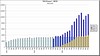
TKS versions 1.0 and 1.1 are shown together under the TKSv1 label. TKS versions 2.0 and 2.1 are shown together in the accumulated bar graph to the right.
Non-Commenting Source Statements differ slightly from Source Lines of Code (SLOC). SLOC counts physical lines (and is therefore more impacted my formatting), whereas NCSS counts source statements regardless of formatting. So, NCSS will always be less than or equal to SLOC for a given code base.
NCSS for TKS/Kowari was generated using JavaNCSS for Java files only.
Thursday, March 31, 2005
The # vs. / Argument Continues
The W3C Semantic Web Best Practices & Deployment Working Group formally weighed into the Technical Architecture Group's httpRange-14 issue last week. I sent this message, noting the unanimous decision by the SWBP to stand against Tim Berners-Lee's position on the issue. As expected, TBL fired back. My response, hopefully clarifying the SWBP position, is here. The full thread is in the SWBP mailing list archives for March, 2005.
It looks like httpRange-14 will be with us for a while yet :)
It looks like httpRange-14 will be with us for a while yet :)
Wednesday, March 30, 2005
Playing the Odds; Venture Capital as Roulette
A recent survey of start-up companies in the Mid-Atlantic region of the United States by Core Capital produced some interesting results. It seems that only 1 in 27 companies which successfully raise an initial ("Series A") VC investment will survive to get a subsequent ("Series B") round. I heard that the number being used in New York City this year is 1 in 30.
Those odds contrast quite severely with the traditional rule of thumb of 1 in 20 (or more markedly with the rule being used in the Dot Com days of 1 in 10).
Let this be a lesson to budding entrepreneurs: This is a tough market. The odds are that venture capital should be avoided. It is expensive money. Only those who don't need the funds can possibly afford to take them. A better avenue for most entrepreneurs is clearly to shift business models, find new customers and wait for better times to bring a new type of product to the market.
That is not to say that my advice is better for VCs. It is not! VCs make money when the 1 in 30 hits. They need to invest in order to have a chance at the occasional return. No, I am making a suggestion solely for the benefit of entrepreneurs. After all, it is your company which will go out of business at the end of the year, not the investment fund.
Those odds contrast quite severely with the traditional rule of thumb of 1 in 20 (or more markedly with the rule being used in the Dot Com days of 1 in 10).
Let this be a lesson to budding entrepreneurs: This is a tough market. The odds are that venture capital should be avoided. It is expensive money. Only those who don't need the funds can possibly afford to take them. A better avenue for most entrepreneurs is clearly to shift business models, find new customers and wait for better times to bring a new type of product to the market.
That is not to say that my advice is better for VCs. It is not! VCs make money when the 1 in 30 hits. They need to invest in order to have a chance at the occasional return. No, I am making a suggestion solely for the benefit of entrepreneurs. After all, it is your company which will go out of business at the end of the year, not the investment fund.
Sunday, March 27, 2005
Kowari Overview Paper Accepted to XTech 2005
I am pleased to say that the Kowari overview paper that I wrote with Paul Gearon and Tom Adams has been accepted to XTech 2005. The conference was formerly called XML Europe and will be held in Amsterdam in May. The paper was entitled "Kowari: A Platform for Semantic Web Storage and Analysis".
Ph.D. Confirmation - Finally!
My Ph.D. advisors, Associate Professor Dave Carrington at UQ and Professor Simon Kaplan, Dean of IT at QUT have accepted my confirmation report and the confirmaton committee has agreed. UQ is grinding its way through the rest of the paperwork, but it looks like I am finally confirmed as a Ph.D. candidate.
My confirmation report was entitled "Anticipating Emergent Properties in Object Oriented Software" and is here for those interested.
My confirmation report was entitled "Anticipating Emergent Properties in Object Oriented Software" and is here for those interested.
Sunday, March 20, 2005
The Semantic Web Initiative and Implications to Publishing
The slides from my keynote at the Semantic Web Workshop at PrintMedia 2005 are here.
Monday, March 14, 2005
TKS/Kowari Development Effort
This graph shows the development effort spent on the Tucana Knowledge Server (TKS) and its Open Source subset, Kowari. The dip in 2003 was caused by the Great Software Recession, when external services contracts reduced development effort. A total of 32599.41 hours were logged on the project between the end of prototyping in May 2001 and the cessation of Tucana operations in the last week of December 2004.
This image was made with the excellent JpGraph graphing library for PHP.
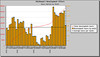
This image was made with the excellent JpGraph graphing library for PHP.
Hormones, Alcohol and Adrenalin
I attended a fascinating auction over the weekend, which raised funds for my daughter's Montessori school. There was a paid dinner for parents (no kids) and both silient and directed auctions. The material auction took two forms: items/services donated by local businesses and items hand-made by the children with help from moms. The latter caused some of the most interesting social behavior I have seen in a while.
A wet bar sucked in drink tickets before the bidding. Smart move. Everyone had the opportunity to view the items beforehand. Many of the mothers present had helped create the hand-made items. Estrogen flowed across the floor too deep to wade across.
A husband and wife were seated to my left. The wife wanted a quilt with her daughter's classmates' names on it so badly she could taste it. The husband became more nervous as his wife pushed the bids higher. She was on the edge of her seat and, as the bidding went North of $300 it was obvious she didn't plan to stop. She bought the item for $325. Five minutes later, during bidding for a replica quilt from a different classroom, the woman was relaxed and chatting comfortably. Why? Because she knew that quilt was worthless. It didn't have her daughter's name on it. The same scenario played out with flower pots, garden benches and bookcases painted in handprints.
Last year's auction raised $17,000. I didn't ask about this year. The $80 bird house and $300 cookbook told the whole story.
A wet bar sucked in drink tickets before the bidding. Smart move. Everyone had the opportunity to view the items beforehand. Many of the mothers present had helped create the hand-made items. Estrogen flowed across the floor too deep to wade across.
A husband and wife were seated to my left. The wife wanted a quilt with her daughter's classmates' names on it so badly she could taste it. The husband became more nervous as his wife pushed the bids higher. She was on the edge of her seat and, as the bidding went North of $300 it was obvious she didn't plan to stop. She bought the item for $325. Five minutes later, during bidding for a replica quilt from a different classroom, the woman was relaxed and chatting comfortably. Why? Because she knew that quilt was worthless. It didn't have her daughter's name on it. The same scenario played out with flower pots, garden benches and bookcases painted in handprints.
Last year's auction raised $17,000. I didn't ask about this year. The $80 bird house and $300 cookbook told the whole story.
Monday, March 07, 2005
# vs. /
Dapper Jeremy Carroll takes on Tim Berners-Lee during the Fourth Annual "Hash versus Slash" Abuse-a-thon at the W3C's Semantic Web Best Practices & Deployment Working Group's March 2005 face-to-face meeting in Boston. Note Patrick Stickler in the background with duct tape over his mouth!
The # vs. / issue is under discussion was the W3C's Technical Architecture Group's HTTP Range 14 issue.

The # vs. / issue is under discussion was the W3C's Technical Architecture Group's HTTP Range 14 issue.
Not My Style
I would like to assure everyone out there that, in spite of recent confusion to the contrary, this image does not depict me :)
Thursday, March 03, 2005
SWBP&D Working Group Face-to-Face Meeting
The Semantic Web Best Practices and Deployment Working Group held its third face-to-face meeting 3-4 March 2005 in Boston. A lot was accomplished, as is common with face-to-face meetings. Teleconferencing, email, IRC and IM aside, people still work fastest with people in the same room.
The Ontology Engineering and Patterns Task Force continues to be the most actively publishing task force. Two documents are moving to W3C Note status shortly, pending final editorial review: Representing Classes As Property Values on the Semantic Web and Representing Specified Values in OWL: "value partitions" and "value sets". Please note that newer editor's drafts exist to both documents. Those links should be updated shortly.
The RDF/Topic Maps Interoperability Task Force is moving their RDF/TM Survey to Working Draft status shortly. It will end up as a W3C Note. A guidelines document for RDF/TM mapping should follow.
More good stuff seems like it will be coming soon.
The Ontology Engineering and Patterns Task Force continues to be the most actively publishing task force. Two documents are moving to W3C Note status shortly, pending final editorial review: Representing Classes As Property Values on the Semantic Web and Representing Specified Values in OWL: "value partitions" and "value sets". Please note that newer editor's drafts exist to both documents. Those links should be updated shortly.
The RDF/Topic Maps Interoperability Task Force is moving their RDF/TM Survey to Working Draft status shortly. It will end up as a W3C Note. A guidelines document for RDF/TM mapping should follow.
More good stuff seems like it will be coming soon.
W3C Tech Plenary 2005
I attended the 2005 W3C Technical Plenary in Boston. The plenary consisted of working group meetings Monday-Tuesday and Thursday-Friday and a common day on Wednesday. The common day was an overview of new work by all projects within the W3C. Some of the interesting (to me) ones were:
XML 1.1 has engendered some controversy. The talk "Where XML is Going, and Where it Should (or Shouldn't) Go" addressed this topic. The most memorable comment was in relation to changes which allow full internationalization in XML 1.1. To paraphrase: "Sure XML 1.1 is backward compatible, but it allows everyone around the world to play. We have an obligation to support the entire world since we are the World Wide Web Consortium." Good thoughts. I fear for the migration issues, though.
Shawn Lawton Henry (W3C; WAI Education and Outreach Working Group) presented a cool usability study undertaken on the Accessibility Guidelines content on the Web entitled "Lost in W3C Web Space". They did a lot of work to make the usually dense W3C specification content much more accessible, even to those users not somehow handicaped. Check out the new site.
The end of day brought some "Lightning Talks" - quick summaries of new work. These were some of the most interesting:
"Topic Maps and the Semantic Web", Steve Pepper (Ontopia; Convenor SC34/WG3, Semantic Web Best Practices Working Group). Steve brought us up to date on the progress mapping RDF and XML Topic Maps. (slides)
"Project SIMILE: Helping build the Semantic Web", Ryan Lee and Stefano Mazzocchi (MIT). The Piggy-Bank plug-in for the Firefox browser is very nice and worth checking out if you are still wondering why the Semantic Web is cool. You can find the plug-in on the project page.
XML 1.1 has engendered some controversy. The talk "Where XML is Going, and Where it Should (or Shouldn't) Go" addressed this topic. The most memorable comment was in relation to changes which allow full internationalization in XML 1.1. To paraphrase: "Sure XML 1.1 is backward compatible, but it allows everyone around the world to play. We have an obligation to support the entire world since we are the World Wide Web Consortium." Good thoughts. I fear for the migration issues, though.
Shawn Lawton Henry (W3C; WAI Education and Outreach Working Group) presented a cool usability study undertaken on the Accessibility Guidelines content on the Web entitled "Lost in W3C Web Space". They did a lot of work to make the usually dense W3C specification content much more accessible, even to those users not somehow handicaped. Check out the new site.
The end of day brought some "Lightning Talks" - quick summaries of new work. These were some of the most interesting:
"Topic Maps and the Semantic Web", Steve Pepper (Ontopia; Convenor SC34/WG3, Semantic Web Best Practices Working Group). Steve brought us up to date on the progress mapping RDF and XML Topic Maps. (slides)
"Project SIMILE: Helping build the Semantic Web", Ryan Lee and Stefano Mazzocchi (MIT). The Piggy-Bank plug-in for the Firefox browser is very nice and worth checking out if you are still wondering why the Semantic Web is cool. You can find the plug-in on the project page.
Wednesday, February 16, 2005
PAW Web Site
The Policy-Aware Web project has a Web site at http://www.policyawareweb.org. Not much there yet :)
Bernadette Hyland on CIT Panel
Tuesday, February 15, 2005
WWW2005 Panel: Can the Semantic Web be Made to Flourish?
I will be convening a panel at WWW 2005 entitled "Can the Semantic Web be Made to Flourish?". The panel has been accepted and will consist of the following panelists: Zavisa Bjelogrlic (Co-founder, @semantics), Bernadette Hyland (Co-founder, Tucana Technologies), Prof. Jim Hendler (Director, MIND Lab, University of Maryland) and Kanzaki Masahide (Consultant, Kanzaki.com). It may be possible to line up another panelist and I am trying to do so.
The panel will try to address the contentious issue of the uptake of the Semantic Web. This clearly relates to my work at the W3C Semantic Web Best Practices & Deployment Working Group. We will discuss business as well as technical barriers to adoption.
WWW 2005 will be held 10-14 May 2005 in Chiba, Japan. The panel is currently scheduled for sometime on 11 May.
The panel will try to address the contentious issue of the uptake of the Semantic Web. This clearly relates to my work at the W3C Semantic Web Best Practices & Deployment Working Group. We will discuss business as well as technical barriers to adoption.
WWW 2005 will be held 10-14 May 2005 in Chiba, Japan. The panel is currently scheduled for sometime on 11 May.
Policy-Aware Web Kickoff Meeting

LAX BSOD
I was passing through LAX in early January and noticed this email terminal with a Blue Screen of Death. Why, oh why, would anyone use Windows for such an application? Still, I suppose it is free marketing, in its way.
And yes, I was immediately accosted upon taking a flash photograph in the airport. "You see, officer, I'm a geek and have this thing against Microsoft... Oh, no, not really against anything, really. I'm quite harmless. I just thought it was funny, see? Officer?" Ah, well. Welcome to the United States. Now keep you head down and your mouth shut.

And yes, I was immediately accosted upon taking a flash photograph in the airport. "You see, officer, I'm a geek and have this thing against Microsoft... Oh, no, not really against anything, really. I'm quite harmless. I just thought it was funny, see? Officer?" Ah, well. Welcome to the United States. Now keep you head down and your mouth shut.
Former Tucana Staff Farewell Party
Former Tucana staff had a farewell party at Brisbane's Paddo Tavern on 25 Jan 2005.


National Geographic Almanac of Geography
I received a request from National Geographic Books last week asking for permission to use this image on the origins of agriculture from my site at the University of Queensland. I gave them copyright permission and hope they actually use the image in their new edition Almanac of Geography. Watch for it :)
The image was created with xplanet. The directions for its creation are here.

The image was created with xplanet. The directions for its creation are here.
Thursday, February 03, 2005
Back to the US
I leave in the morning for the US. It will be wonderful to return to my family! Still, I'm going to miss summer in Brisbane, with its sunshine, mangos and good friends. See you on the other side of the Big Pond.
Little Crawly Things
I awoke this morning with an itchy line of flea bites on my left leg. I haven't had flea bites since, well, the last time I was in Brisbane during the summer. Later in the morning, I walked straight into a meter-wide spider web trying to get to the laundry under the house. You can generally get right out of it by immediately backing away. It simply peels off your face. The 5-cm female was, I think, a type of orb weaver. It takes a while to get used to living with so many insects and arachnids when one has been away from it for a while. There are so many in Australia that some people even expand their bird-watching to include spiders.
Tuesday, February 01, 2005
Kowari as a Data Set
My Ph.D. direction was a lot to chew. Although I have made a career out of ignoring people's advice when something was hard, I had to take it this time. I have had many suggestions that my thesis was going to be problematic because it was so interdisciplinary and therefore hard to find places to publish. An anthropolical journal might say that a complex systems journal should publish a given paper, and a complex systems journal might suggest that it belongs in archaeology, and so on. So, I am changing direction and taking the advice to continue work on the fundamental problem of the origin of agriculture following graduation. The new direction is a complex systems analysis of the Kowari codebase. Simple, short, bounded and relatively easy to publish. Whew!
Kowari is interesting for several reasons, the most important of which are:
The knowledge of what happened when is the kicker. Many Open Source projects could claim the first two, but they don't typically have any way to corrolate what developers were doing during the development of the project. That data should allow some interesting analyses to be done, such as how "busy" objects changed during the development lifecycle, the relationship between a scale-free network representation of the code and major changes to the codebase, and whether I can manage to develop an algorithm to represent the increasing complexity of the project over time. That last one is interesting since it may be possible to develop a better metric for evaluating "build vs. buy" decisions than source lines of code counters.
Dave Carrington at UQ will become my associate supervisor and Simon Kaplan (now Dean of the Faculty of Information Technology at QUT) will remain my primary supervisor. I will stay enrolled at UQ.
Watch this space for the results.
Kowari is interesting for several reasons, the most important of which are:
- It is a large, enterprise product with actual users.
- We have a substantial cvs history for it.
- We have recorded knowledge of what developers were doing during its development.
The knowledge of what happened when is the kicker. Many Open Source projects could claim the first two, but they don't typically have any way to corrolate what developers were doing during the development of the project. That data should allow some interesting analyses to be done, such as how "busy" objects changed during the development lifecycle, the relationship between a scale-free network representation of the code and major changes to the codebase, and whether I can manage to develop an algorithm to represent the increasing complexity of the project over time. That last one is interesting since it may be possible to develop a better metric for evaluating "build vs. buy" decisions than source lines of code counters.
Dave Carrington at UQ will become my associate supervisor and Simon Kaplan (now Dean of the Faculty of Information Technology at QUT) will remain my primary supervisor. I will stay enrolled at UQ.
Watch this space for the results.
Consulting in 2005
Whew! It has been a whirlwind couple of weeks. I have been staying with friends in Brisbane, Australia while closing Tucana's Australian office, working on my Ph.D. research and starting some consulting work. I leave for the US on Sunday and should be blogging more regularly.
It should be an interesting year. I am pleased to report that I have accepted a part-time position as "entrepreneur in residence" at Jim Hendler's MIND Lab at the University of Maryland [1]. I will start there in February. Bernadette, Jim and I will also consult together through Software Memetics. I have also started a part-time gig consulting to Data Infinity, helping them to enhance their very interesting Intervis product. Life is starting is look fun again.
It should be an interesting year. I am pleased to report that I have accepted a part-time position as "entrepreneur in residence" at Jim Hendler's MIND Lab at the University of Maryland [1]. I will start there in February. Bernadette, Jim and I will also consult together through Software Memetics. I have also started a part-time gig consulting to Data Infinity, helping them to enhance their very interesting Intervis product. Life is starting is look fun again.
Friday, January 07, 2005
Why Does H-P Software Suck?
Hewlett-Packard makes great hardware, but the company's commercial software is often of very poor quality. Pixelated images in installers and icons, untested conditions, memory leaks, the problems are obvious to even end users. Why should this be so?
I had an interesting problem with my home printer yesterday, an H-P Officejet d145. I was attempting to fax a document to Australia from the US. The number naturally started with the US international access code 011, followed by the country code for Australia, 61, and the city code for Brisbane, 7. I had tested the number from my telephone handset to ensure that I heard both an Australian ring tone and a fax on the other end, but dialing from the H-P Officejet consistently resulted in reaching a US number in the 617 area code. The only thing I can figure is that an H-P programmer decided without thinking to strip leading zeros from a dialed number. That would result in a connection to a US number in the 617 area code. Hmph.
H-P is an international corporation with engineers, programmers and presumably QA people scattered around the world. Surely someone would have tested this condition?
My solution was to attach a telephone handset to the printer and dial from there. Once the fax on the other end was reached, the printer could highjack the line by manually starting a fax transmission. "If it is stupid but it works, it is not stupid". It may, however, be annoying.
I had an interesting problem with my home printer yesterday, an H-P Officejet d145. I was attempting to fax a document to Australia from the US. The number naturally started with the US international access code 011, followed by the country code for Australia, 61, and the city code for Brisbane, 7. I had tested the number from my telephone handset to ensure that I heard both an Australian ring tone and a fax on the other end, but dialing from the H-P Officejet consistently resulted in reaching a US number in the 617 area code. The only thing I can figure is that an H-P programmer decided without thinking to strip leading zeros from a dialed number. That would result in a connection to a US number in the 617 area code. Hmph.
H-P is an international corporation with engineers, programmers and presumably QA people scattered around the world. Surely someone would have tested this condition?
My solution was to attach a telephone handset to the printer and dial from there. Once the fax on the other end was reached, the printer could highjack the line by manually starting a fax transmission. "If it is stupid but it works, it is not stupid". It may, however, be annoying.
Saturday, January 01, 2005
Change in Virtual Real Estate
Happy New Year!
I have new digs and didn't even have to move boxes. With the recent changes at Tucana, I have started a consulting company for the first time in ten years.
You may now reach me at Software Memetics (http://www.softwarememetics.com/). My new email address is david@NOSPAM.softwarememetics.com (please remove "NOSPAM." before sending).
I look forward to staying in touch in the new year.
I have new digs and didn't even have to move boxes. With the recent changes at Tucana, I have started a consulting company for the first time in ten years.
You may now reach me at Software Memetics (http://www.softwarememetics.com/). My new email address is david@NOSPAM.softwarememetics.com (please remove "NOSPAM." before sending).
I look forward to staying in touch in the new year.
Group Think
My recent experiences with certain people who shall remain nameless have caused me to think about the "group think" phenonenon. It turns out that a very simple agent model yields the appropriate emergent behavior. My model is a drastic simplification of Thomas Schelling's investigations of social systems.
The model follows the behavior of agents which may have one of two possible "opinions". The two possible opinions are represented by a color, red or green. Turtles may change their opinion on each turn based on the dominant opinion of their neighbors, thus showing the effects of a simple form of the "group think" phenomenon.
The model shows how the opinions of individuals rapidly form large-scale patterns. The model itself, with documentation, is here.
The model follows the behavior of agents which may have one of two possible "opinions". The two possible opinions are represented by a color, red or green. Turtles may change their opinion on each turn based on the dominant opinion of their neighbors, thus showing the effects of a simple form of the "group think" phenomenon.
The model shows how the opinions of individuals rapidly form large-scale patterns. The model itself, with documentation, is here.
Thursday, December 30, 2004
Free Speech
I have recently been informed that some of the comments on this Weblog are offensive. Some people, apparently, do not agree with my opinions. And that is supposed to be news? People have opinions and these pages reflect mine. They are not the opinions of any company for which I have ever worked.
It has also been suggested that some of my comments here are somehow unpatriotic. They are not. Get over it. I have opinions on the actions of every administration. I can also see interesting statistical corrolations without being unpatriotic. Those who think not should keep in mind that I am a medically retired naval officer who gave my health, and nearly my life, to my country. Unpatriotic? I think not.
To any of you who would criticize these pages I say this: Feel free. That is what free speech is all about. But don't expect me to change my mind in the face of anything other than a reasoned argument.
It has also been suggested that some of my comments here are somehow unpatriotic. They are not. Get over it. I have opinions on the actions of every administration. I can also see interesting statistical corrolations without being unpatriotic. Those who think not should keep in mind that I am a medically retired naval officer who gave my health, and nearly my life, to my country. Unpatriotic? I think not.
To any of you who would criticize these pages I say this: Feel free. That is what free speech is all about. But don't expect me to change my mind in the face of anything other than a reasoned argument.
Wednesday, December 29, 2004
Changes at Tucana Technologies
Tucana Technologies is undergoing some major structural changes that will impact the way our technology is fielded and supported. Watch this space to get the announcements when they come.
The official board position that was posted here a while ago has been changed. In an effort to avoid confusion, I am not going to report their position until it is final.
The official board position that was posted here a while ago has been changed. In an effort to avoid confusion, I am not going to report their position until it is final.
Tuesday, December 07, 2004
Go Canadian?
CNN has a story on an American T-shirt company who "has a solution for their fellow citizens who want to vacation in Europe without having to answer questions about U.S. politics -- pose as Canadians." The kit offers Canadian patches, t-shirt and a phrase book, eh?
How did it come to this? Two generations of American chief executives hell-bent on protecting and expanding the power of the executive branch, that's how. Naturally, that undermines the careful checks-and-balance system laid down by the founding fathers. Sigh. I wonder if George Bush realizes that the Great Seal of the United States of America shows a bald eagle facing the olive branch of peace in its right talons, not the arrows of war in its left? No, perhaps he has been reading the Chinese Book of the Lord Shang: "If things are done that an enemy would be ashamed to do, there is an advantage".
How did it come to this? Two generations of American chief executives hell-bent on protecting and expanding the power of the executive branch, that's how. Naturally, that undermines the careful checks-and-balance system laid down by the founding fathers. Sigh. I wonder if George Bush realizes that the Great Seal of the United States of America shows a bald eagle facing the olive branch of peace in its right talons, not the arrows of war in its left? No, perhaps he has been reading the Chinese Book of the Lord Shang: "If things are done that an enemy would be ashamed to do, there is an advantage".
Subscribe to:
Posts (Atom)